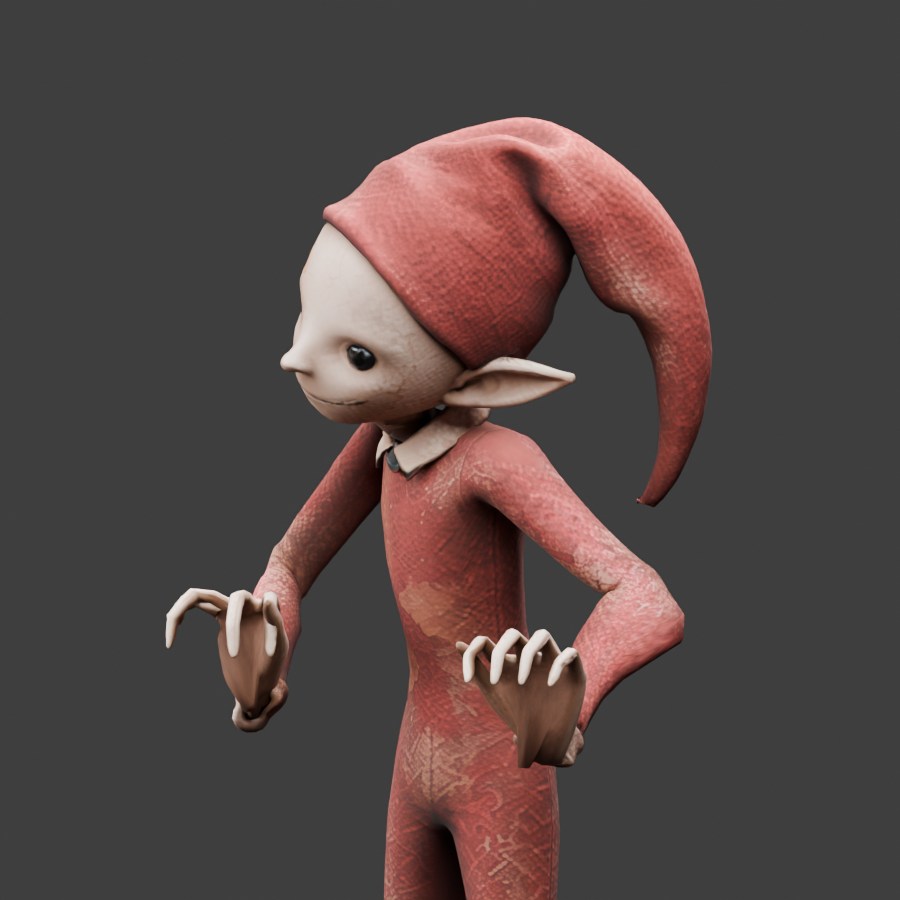
The Elf begins with a contrast: a warm Christmas house, ordinary chores, and a small figure that should be harmless.
I wanted a warm Christmas house to feel safe at first, then make a familiar little toy feel threatening. I brought an existing game concept and earlier visual development into this Unreal and UEFN project.
The tension I wanted was simple: by day, children do chores and prepare the house; at night, watching the elf becomes a shared responsibility. Light, attention and movement compete. My job was to make that idea readable in a more tactile, atmospheric world.
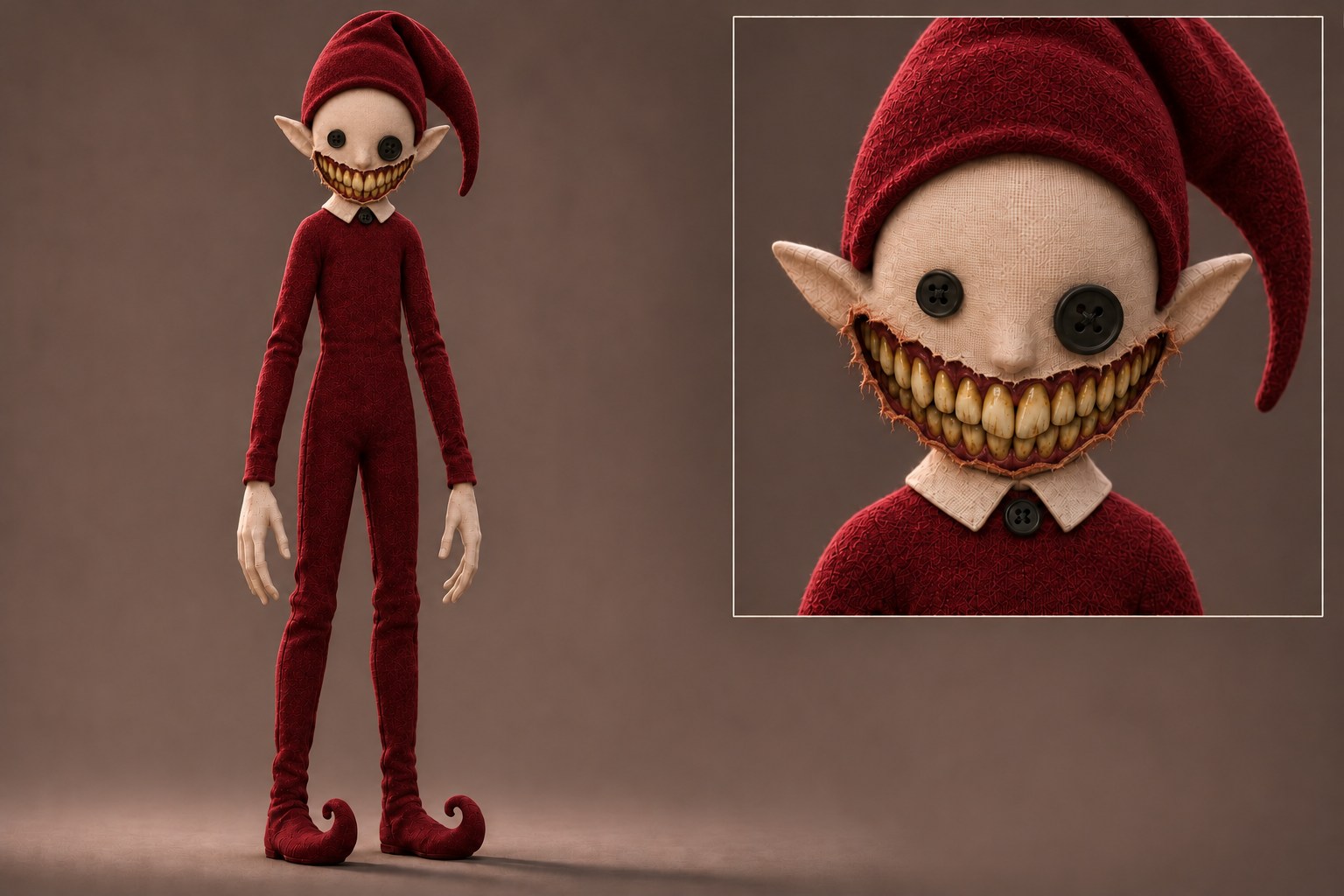
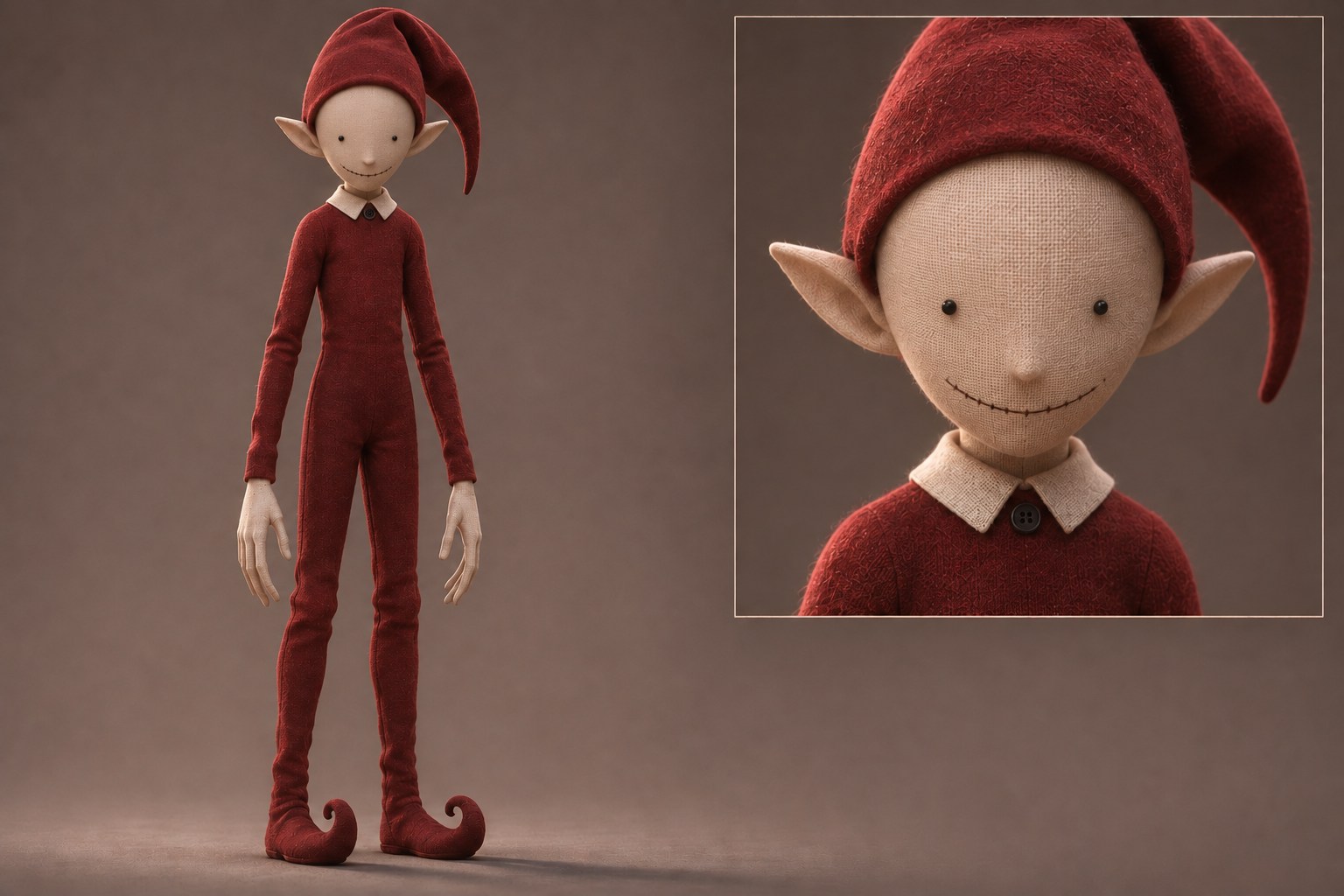
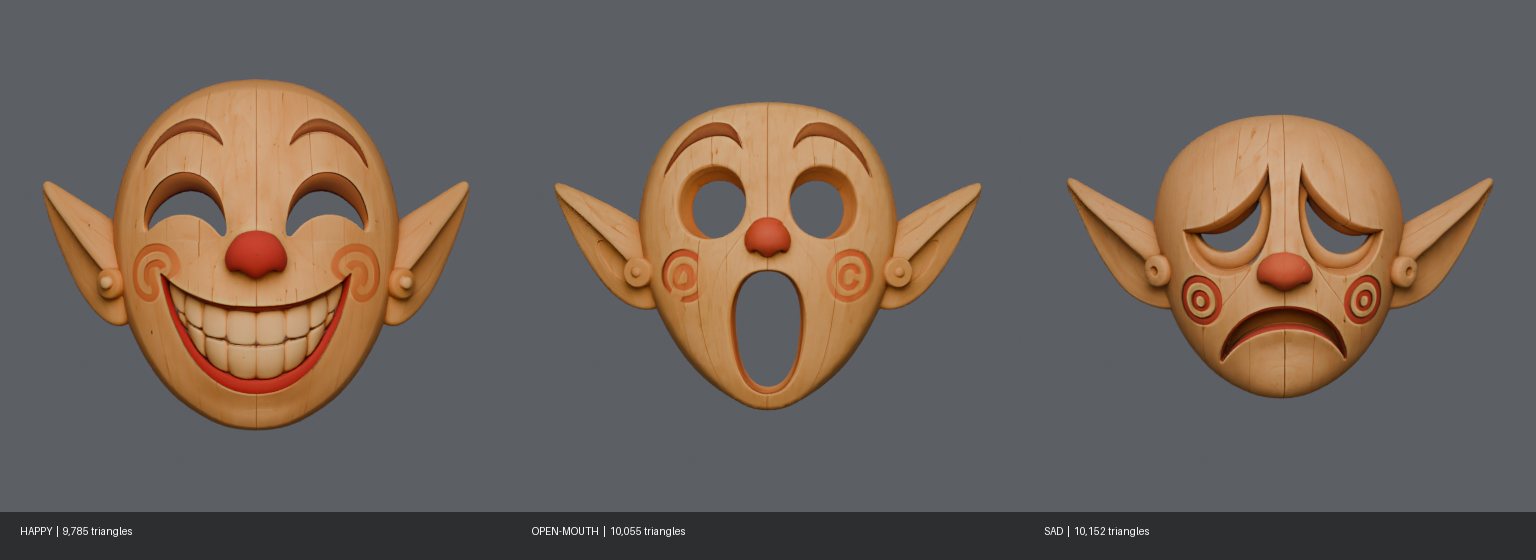
Concept art The open-mouth elf study juxtaposes a familiar toy silhouette with an exaggerated toothy expression.
Chapter 02
Direction means choosing, then correcting
More detail did not always make the elf more frightening.
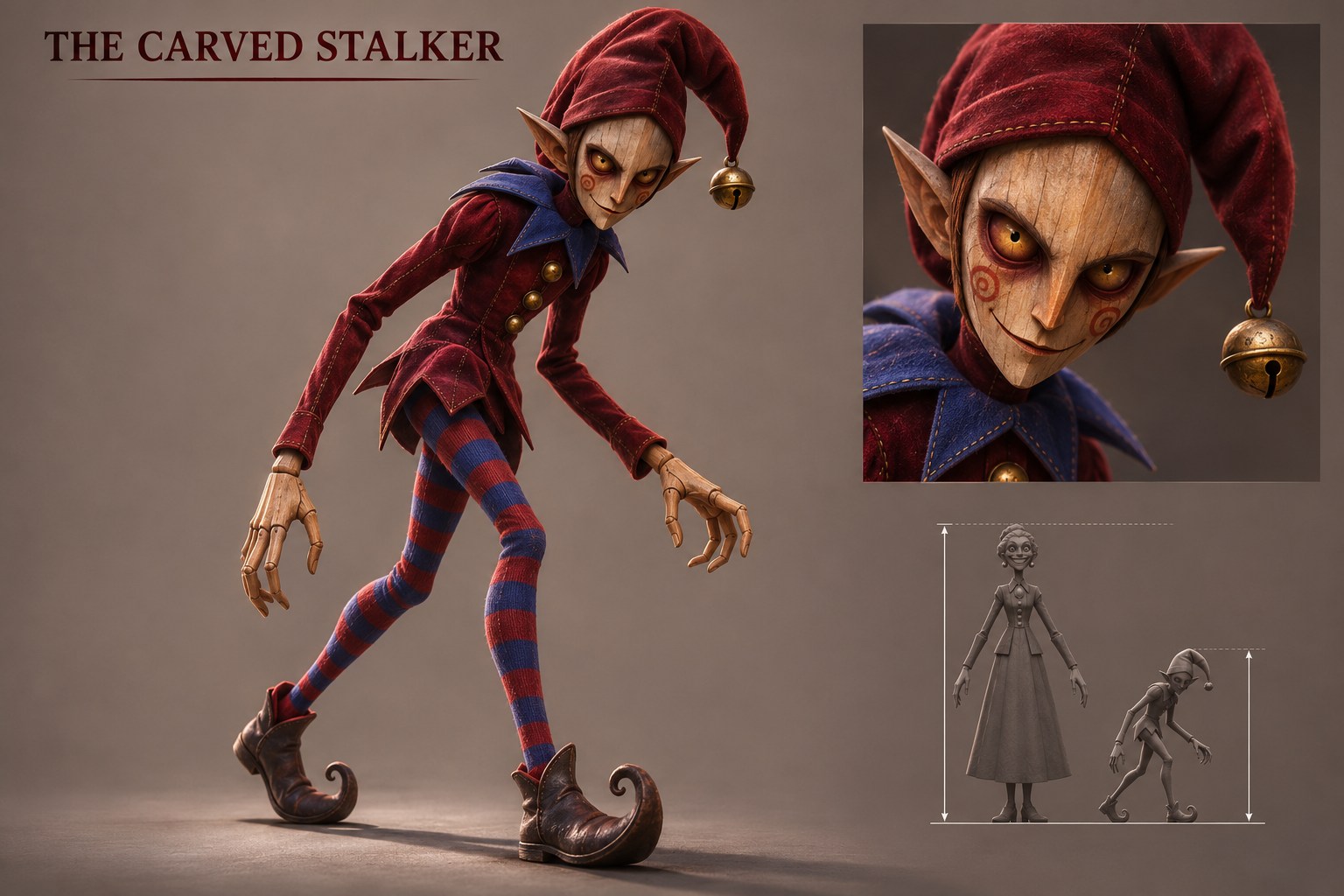
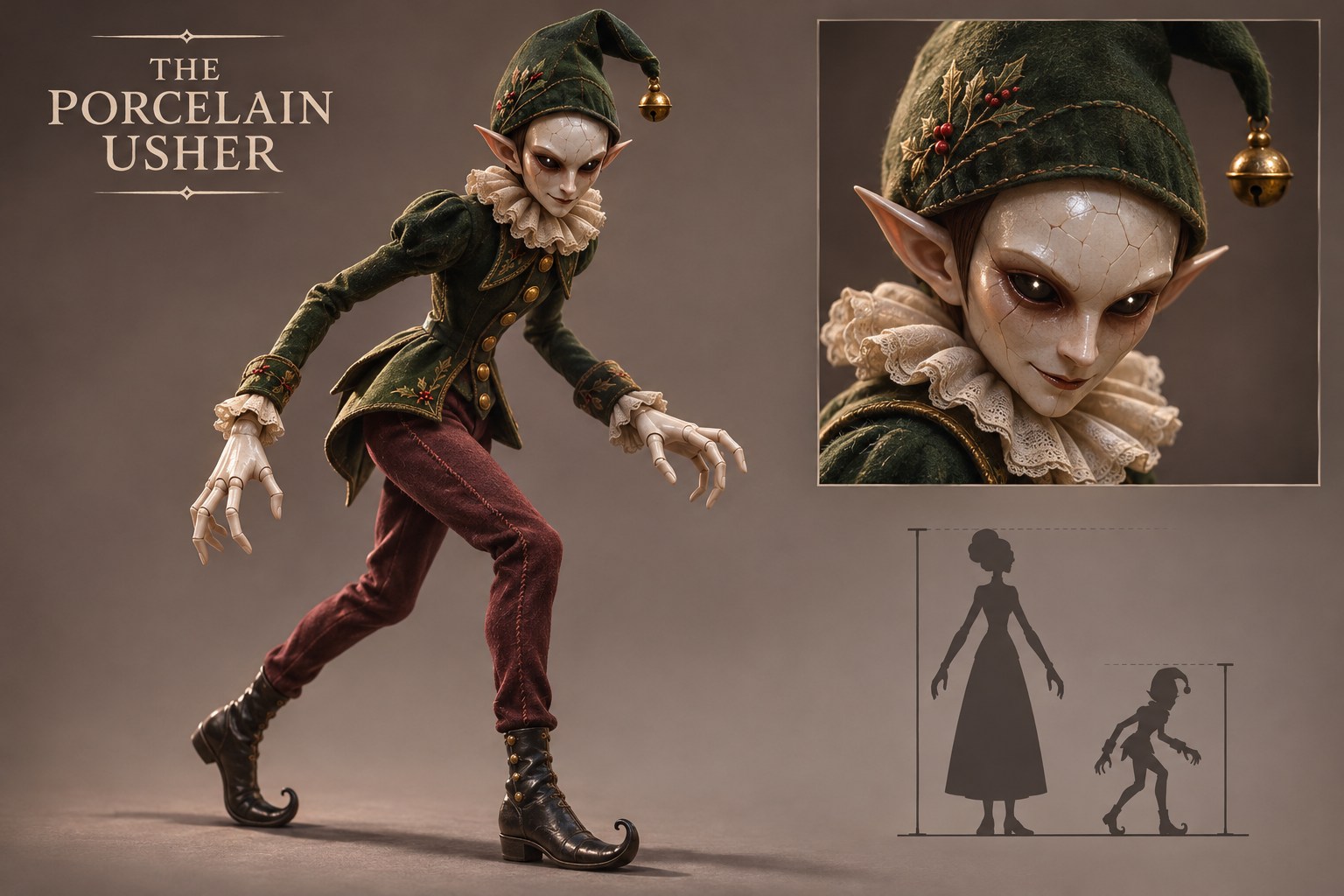
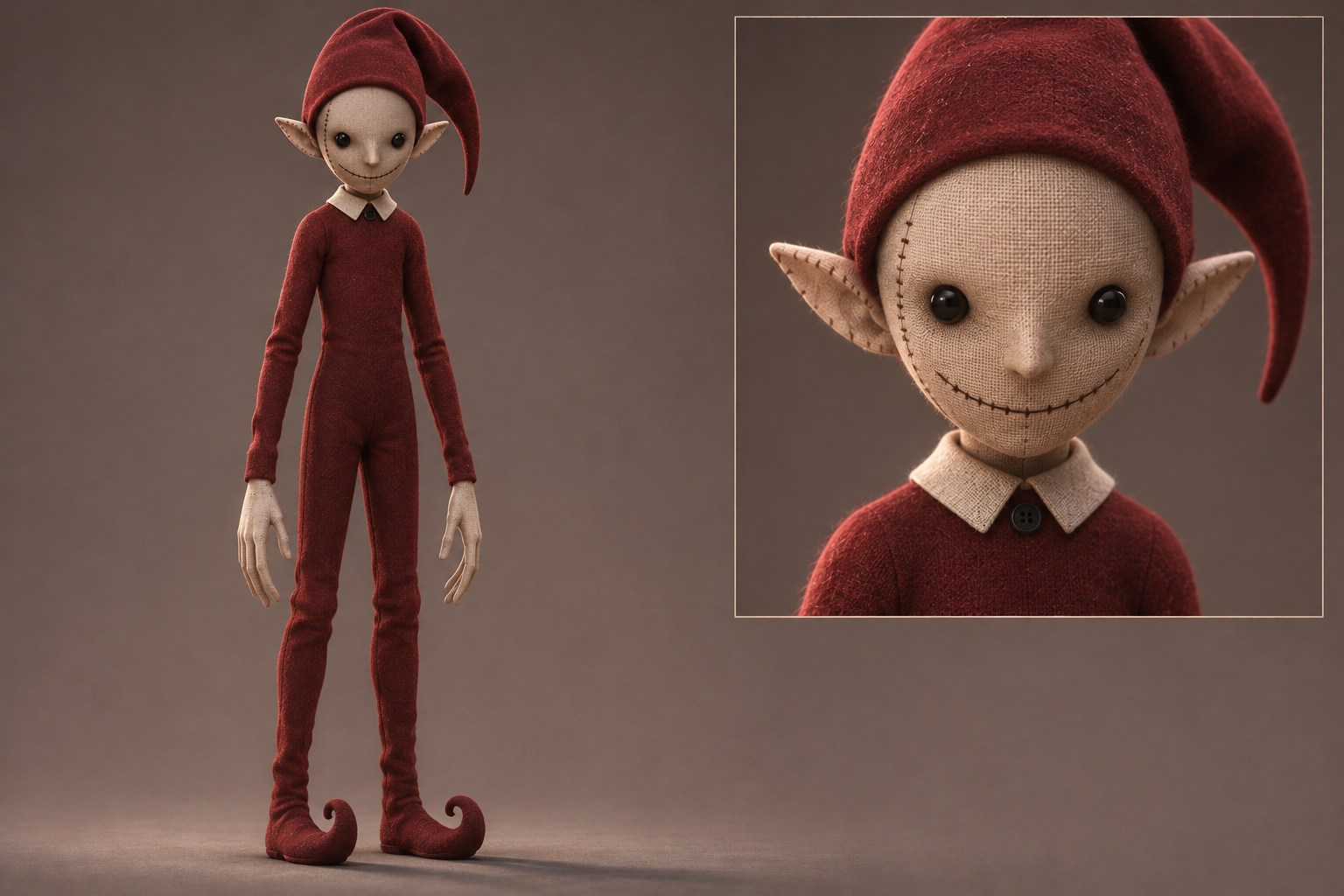
I explored several directions: a carved stalker, a porcelain usher and a threadbare toy. Then I asked for simpler faces. Button-like eyes and restrained expressions made the later toothy reveal feel more unsettling.
I also explored child portraits that gradually became more elf-like. These were storytelling studies. They helped me find the mood without committing every variation to the game.
An anatomy review caught problems in one generated turnaround: the hands, finger spread and shoes did not agree across views. I kept that set out of the modeling references. A convincing single image was not enough; the views had to describe the same character.
“also try a plainer/simpler one too to see if a simpler one can also invoke fear”
My direction, recorded during development.
Concept art Concept art, not gameplay. Referenced in the art-direction chat.Concept art Concept art, not gameplay. Referenced in the art-direction chat.Concept art Concept art, not gameplay. Referenced in the art-direction chat.Concept art Concept art, not gameplay. Referenced in the art-direction chat.
Chapter 03
From pictures to things a house can hold
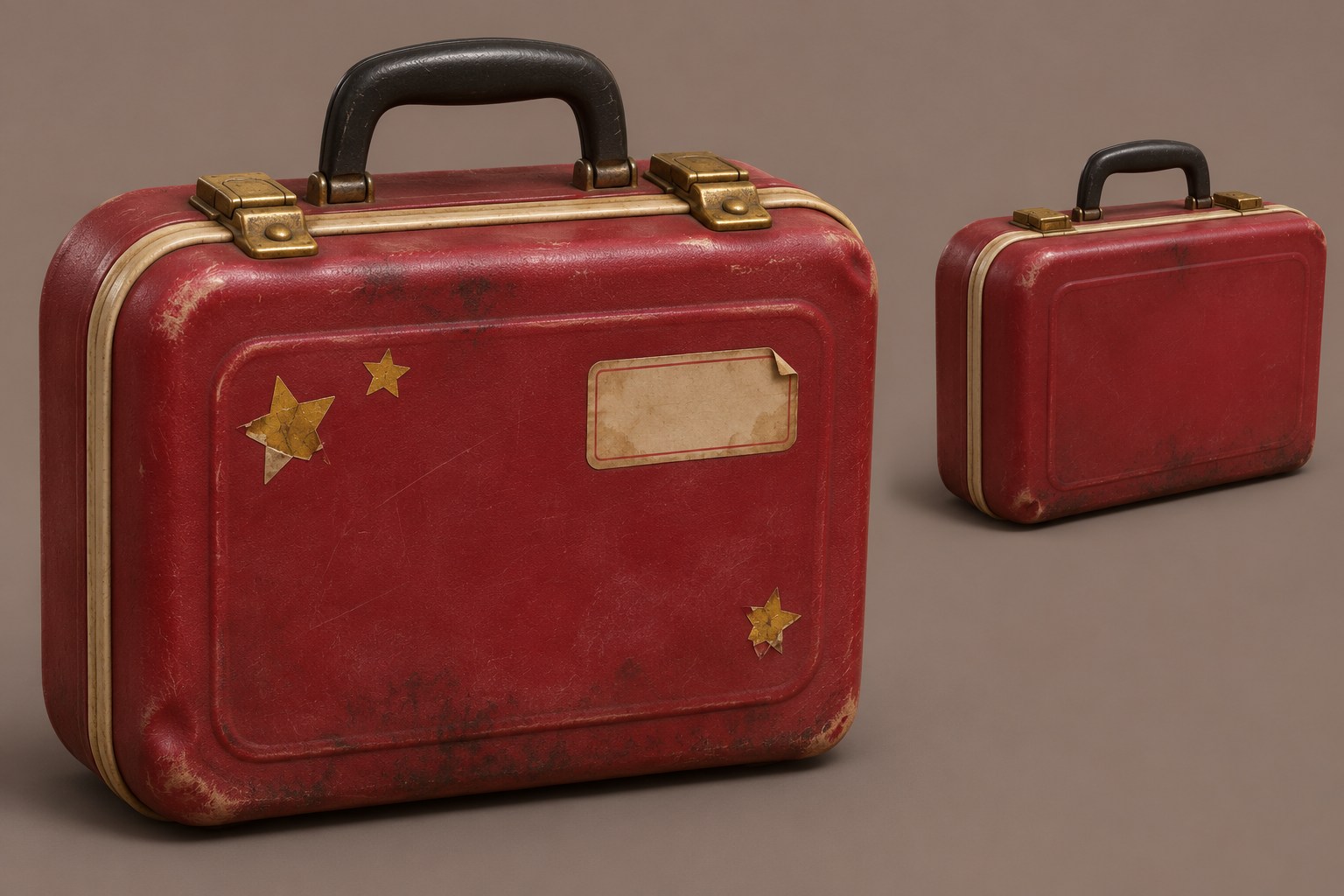
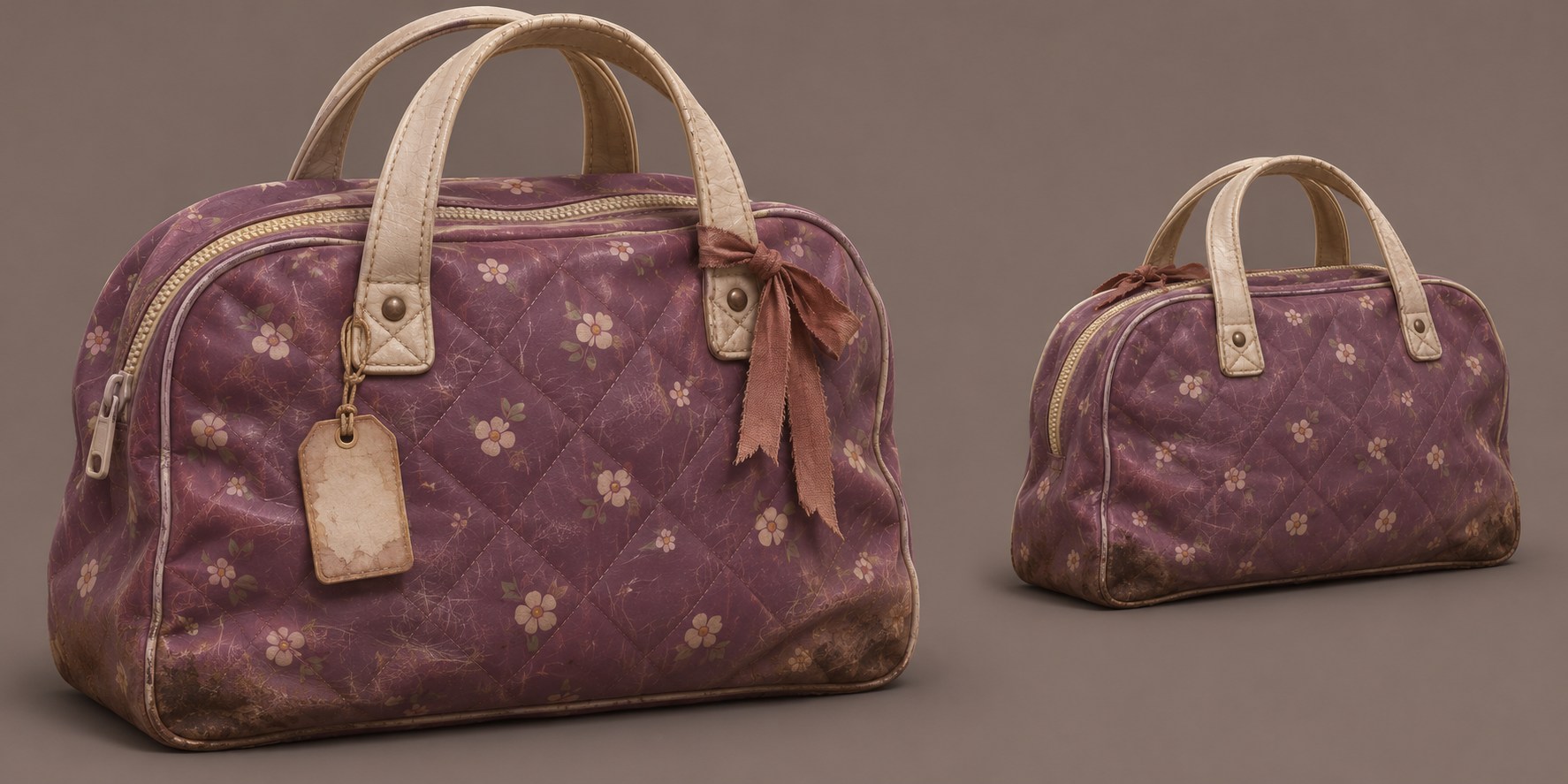
The luggage studies turned a shared visual language into production references.
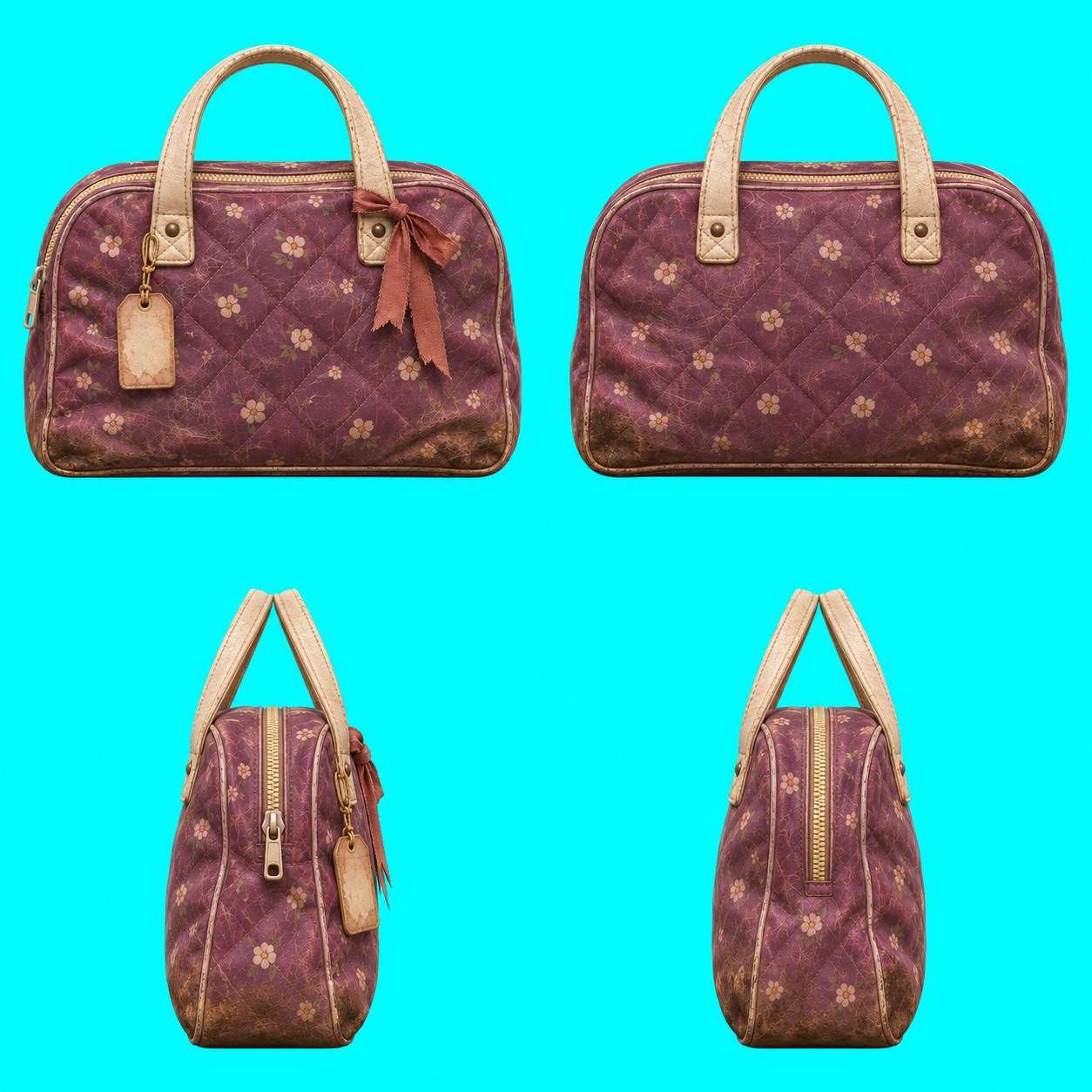
I wanted the luggage to look as though it belonged in the same house. Worn leather, cloth panels, brass details and small holiday motifs gave the bags a shared style while keeping their silhouettes distinct.
I moved from attractive concepts to front, side and rear reference sheets that could guide image-to-3D work. The process recordings show that journey between images, asset tools and the development workspace.
I have kept these as process recordings. A model preview shows one stage of making an object, while the in-game captures show how it behaves in the actual environment.
Concept art Concept art, not gameplay. Referenced in the art-direction chat.Concept art Concept art, not gameplay. Referenced in the art-direction chat.Concept art Concept art, not gameplay. Referenced in the art-direction chat.Concept art Concept art, not gameplay. Referenced in the art-direction chat.
Chapter 04
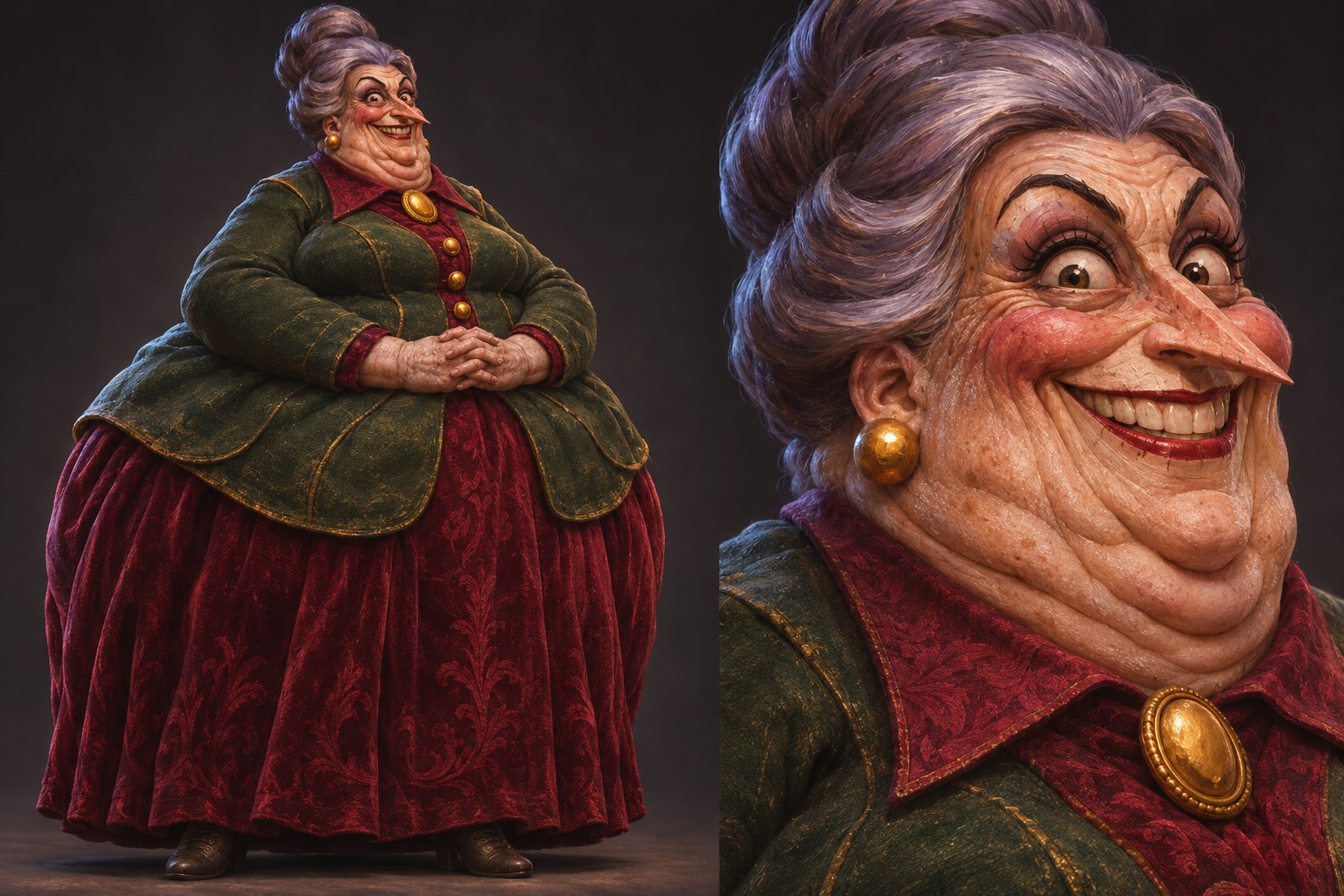
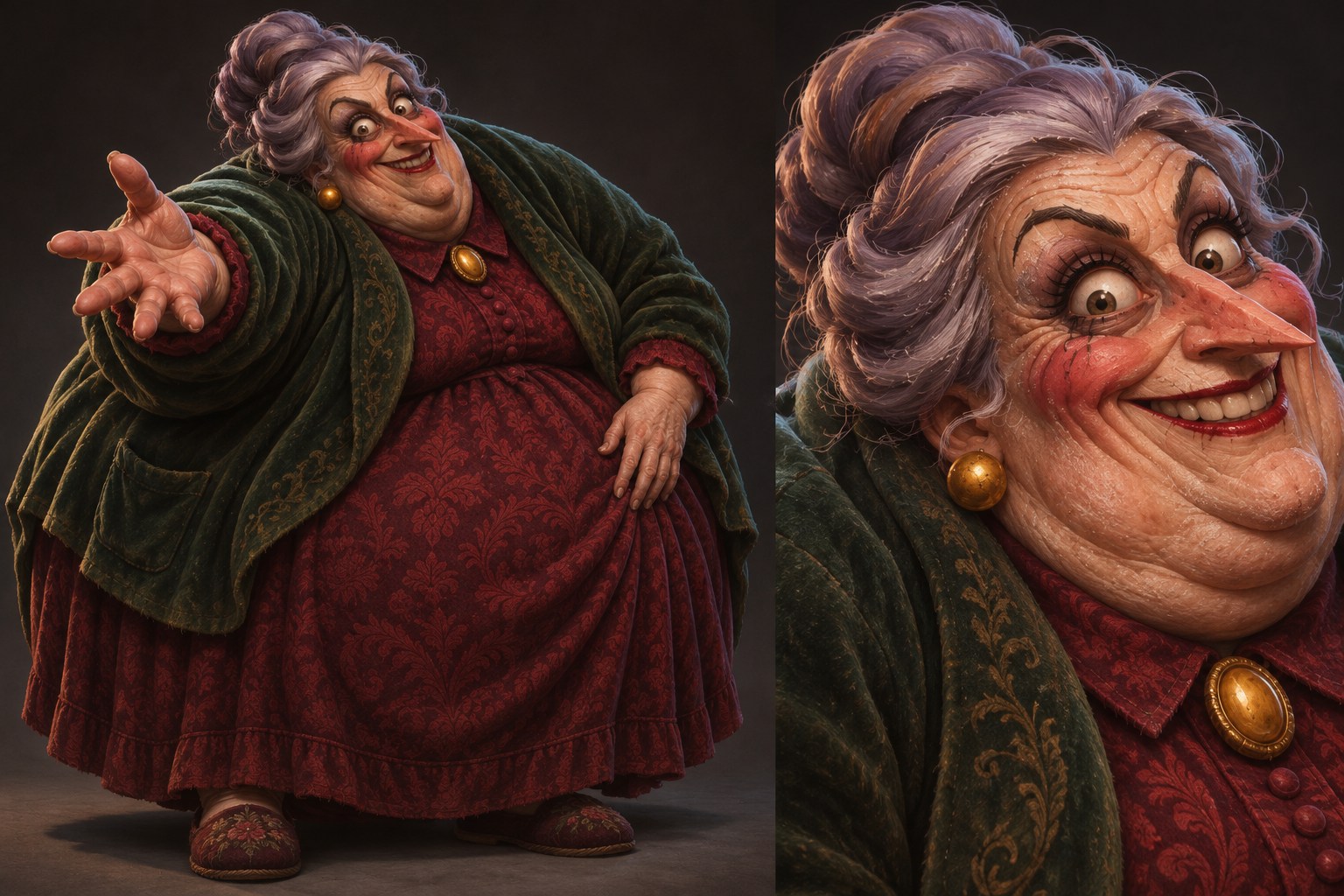
The Matron needed a different silhouette
A character cast needs contrast before it needs more decoration.
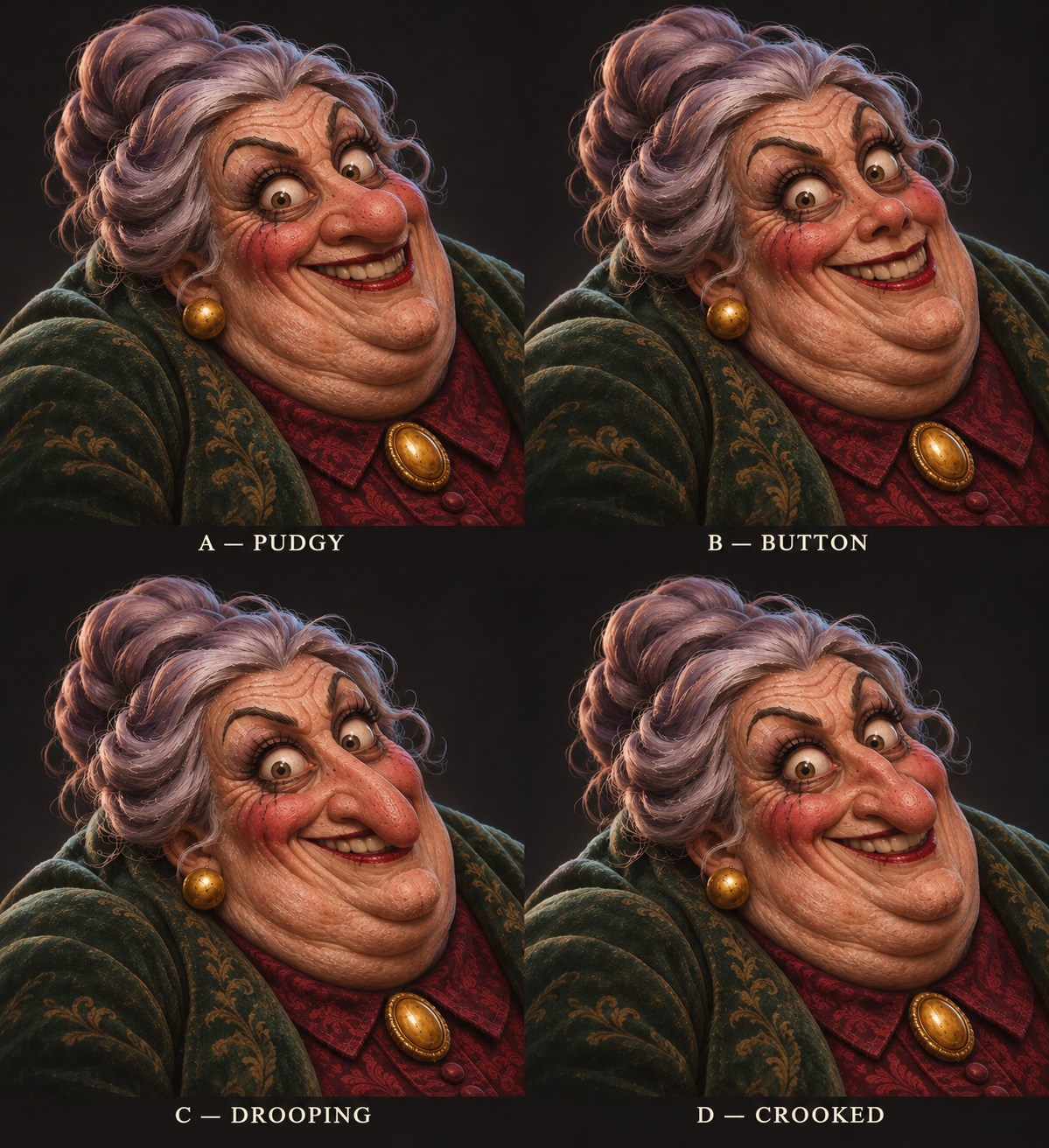
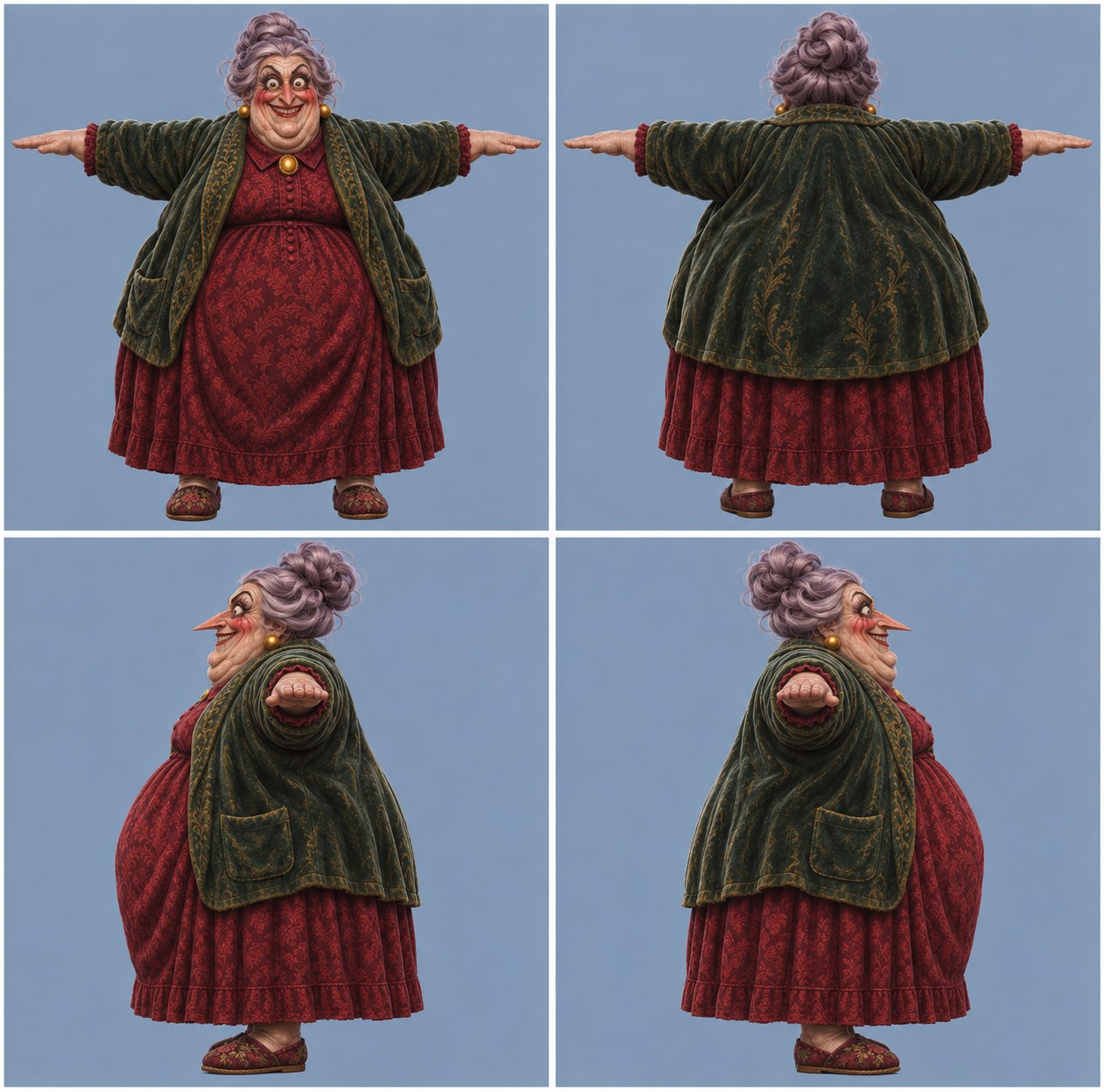
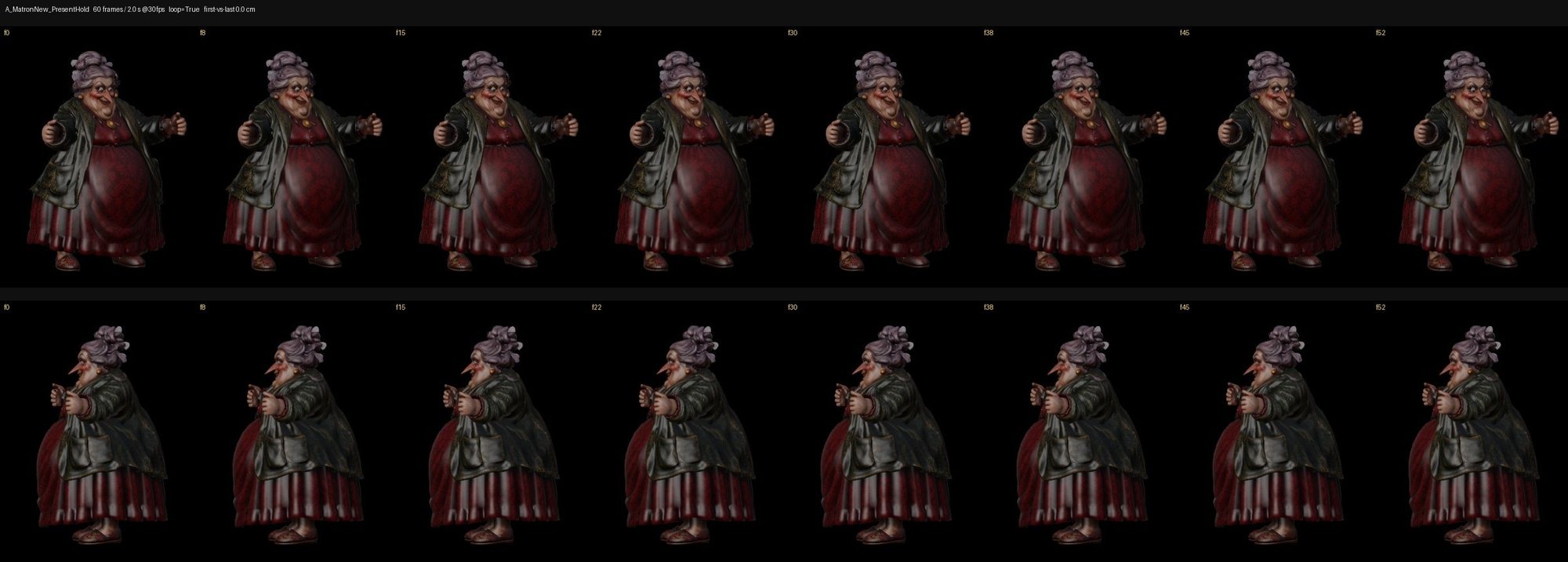
I wanted the Matron to contrast with the thin elves, so I pushed her toward a much broader silhouette while keeping her clothing and theatrical facial character. I explored three directions, then facial variations and a multi-view modeling reference.
I chose the pointier nose. The short performance clip helped me judge how her expression and shape read in motion. It is a character preview, before the separate work of patrol behavior and game integration.
“okay i like the pointy version best.”
My direction, recorded during development.
Concept art Concept art, not gameplay. Referenced in the art-direction chat.Concept art Concept art, not gameplay. Referenced in the art-direction chat.Concept art Concept art, not gameplay. Referenced in the art-direction chat.Concept art Concept art, not gameplay. Referenced in the art-direction chat.
Chapter 05
One mesh. Four players. No drifting seams.
A small material task exposed a limitation of generative editing.
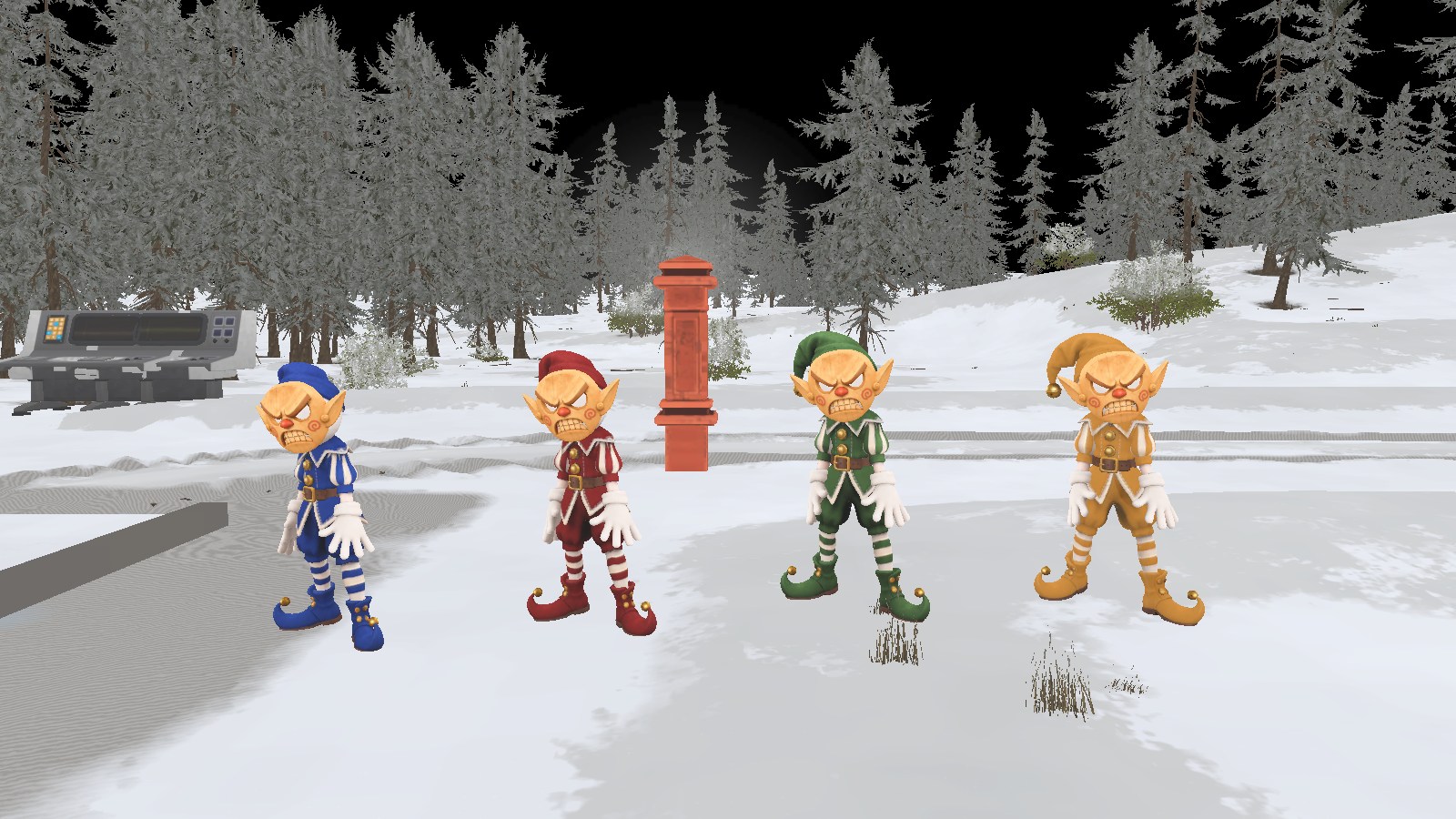
I needed four costume colors on the same mesh: blue, red, green and yellow. Early generated texture atlases shifted the details. A texture could look plausible by itself while moving stripes and seams on the model.
I asked for the original to be preserved exactly. The workflow changed to a precise recolor of the existing atlas, using the generated palettes as color references. The UV layout stayed fixed, and pixels outside the blue mask were preserved.
The four material assignments were saved and validated in UEFN. This editor image let me compare the colors together. It records the appearance check; four-client multiplayer testing was a separate step.
“Yes, preserve the original exactly”
My direction, recorded during development.
UEFN editor Corrected blue, red, green and yellow costumes in the UEFN editor. This image demonstrates the material variants, not four-client multiplayer behavior.
Chapter 06
Hands that work beyond a still frame
First-person sleeves and white gloves had to survive a complete animation.
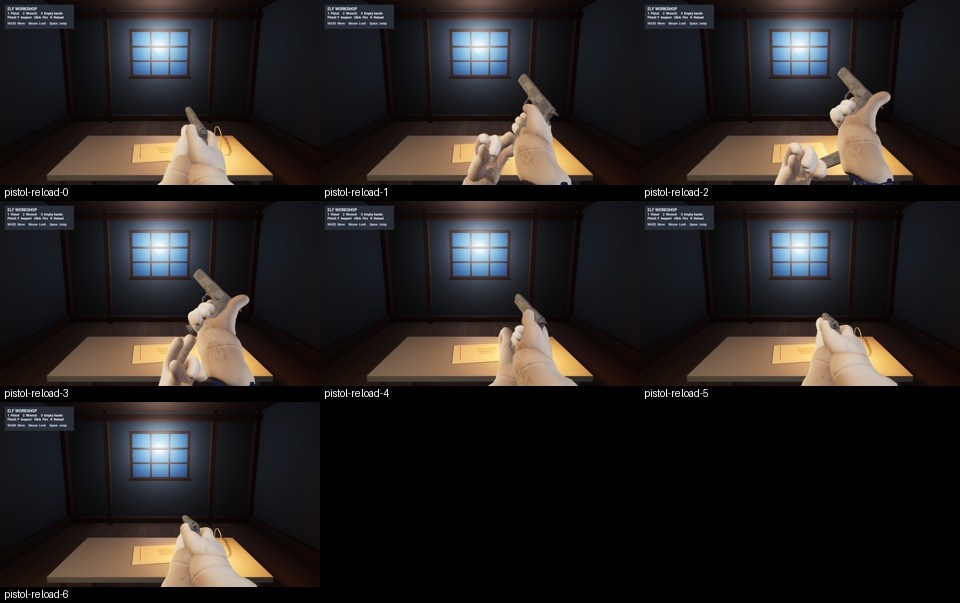
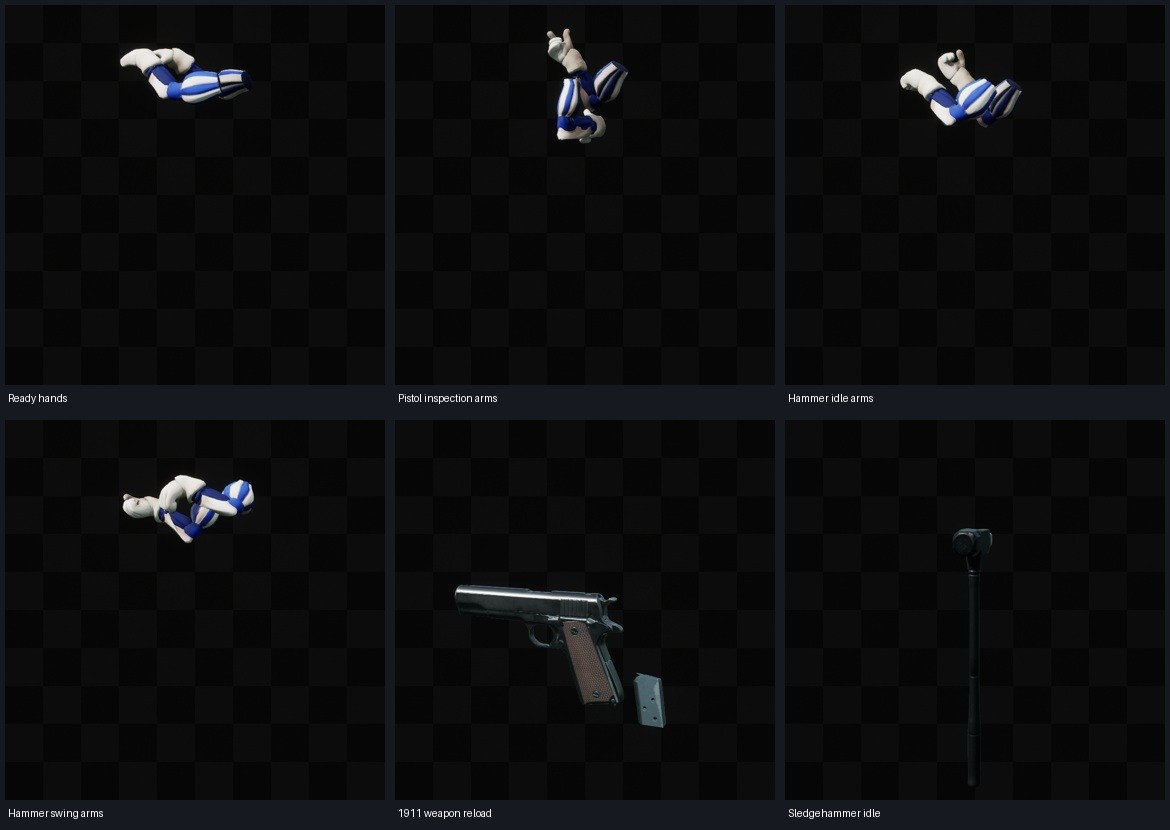
I wanted to see sleeves and white gloves when looking through the character’s eyes. I used a Mac Unreal lab to test them with held items and purchased animations. The demo let me switch items, inspect a pistol, reload and swing a hammer.
A full-body wrench turn exposed the sleeve ends, so that motion was left out. Later, an import-axis problem twisted the mesh in UEFN even though the animation tracks looked correct. Fixing the bind pose and watching the native previews mattered more than a successful import message.
The migration report recorded 41 validated UEFN assets, including four meshes, three skeletons and 17 animation clips. Each clip was sampled at five points against the Mac source. I had approved an asset demo; connecting it to the game’s first-person system was still separate work.
Unreal prototype Mac Unreal Play-in-Editor reload sequence. This was an animation prototype; it did not implement ammunition or damage gameplay.UEFN asset preview Native UEFN animation previews after the bind-axis correction. Asset migration evidence, not a playable first-person system.
Chapter 07
The world has to push back
The full-body elf workshop tested travel, falling, recovery and contact.
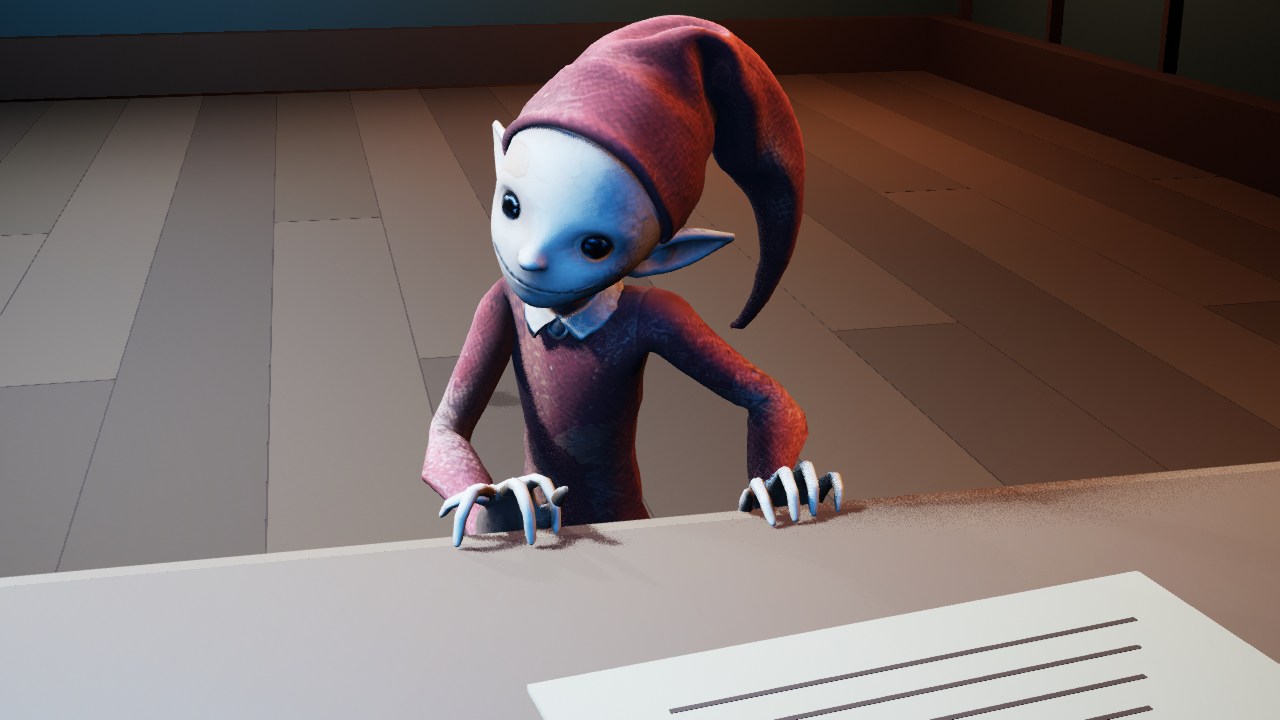
I wanted the full-body elf to feel connected to the room. An 8.93-second Unreal rehearsal showed it run, fall forward, recover and reach a desk. The prepared character used an 83-bone skeleton and a 24,679-triangle mesh at 96 cm tall.
The preparation work repaired skin separation at texture seams and adjusted the hands against the desk. I used this controlled scene to judge movement and contact. The fall was baked animation, and the grip was authored for that particular desk.
The resulting animations, editable rig and validation notes were prepared for Windows integration. That made the experiment something I could carry forward, with its limits recorded alongside the assets.
Unreal prototype Unreal workshop frame: an authored hand-contact pose against the lab desk. The fall is baked and the desk grip is calibrated to that surface.Mesh preparation Skinning revision kept coincident vertices at UV splits together. A mesh preparation view, not a final game screenshot.
Chapter 08
From gray boxes to a house
I wanted to walk every hallway before anyone made it pretty.
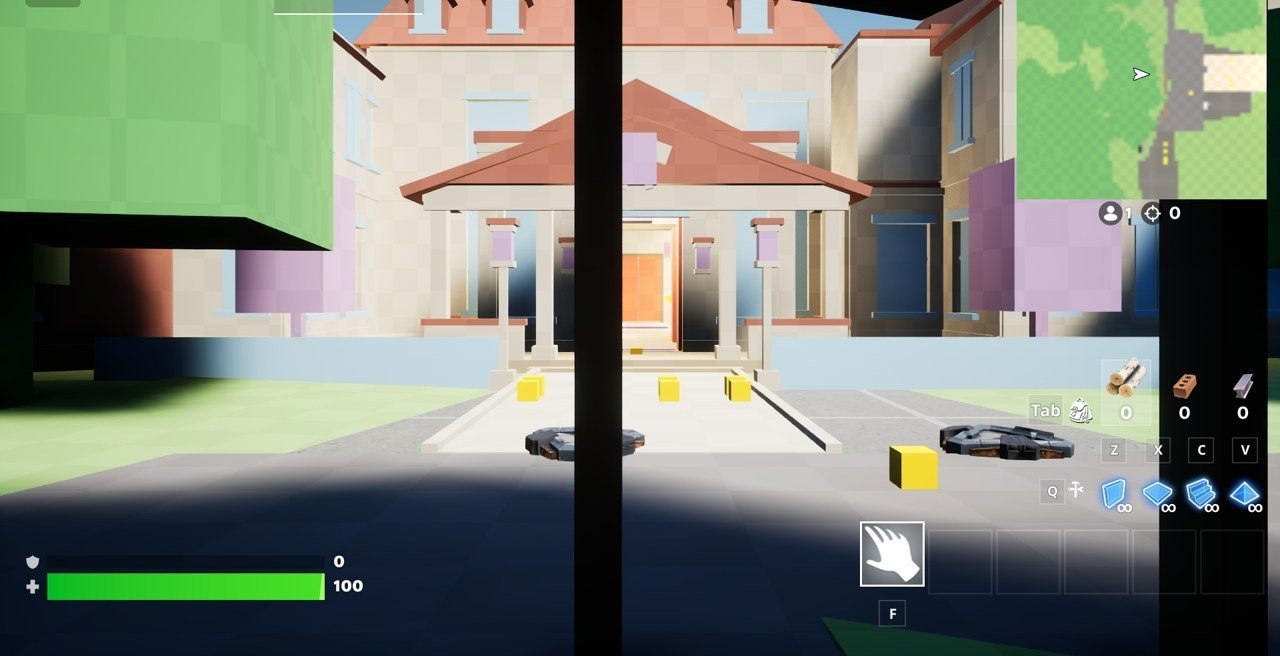
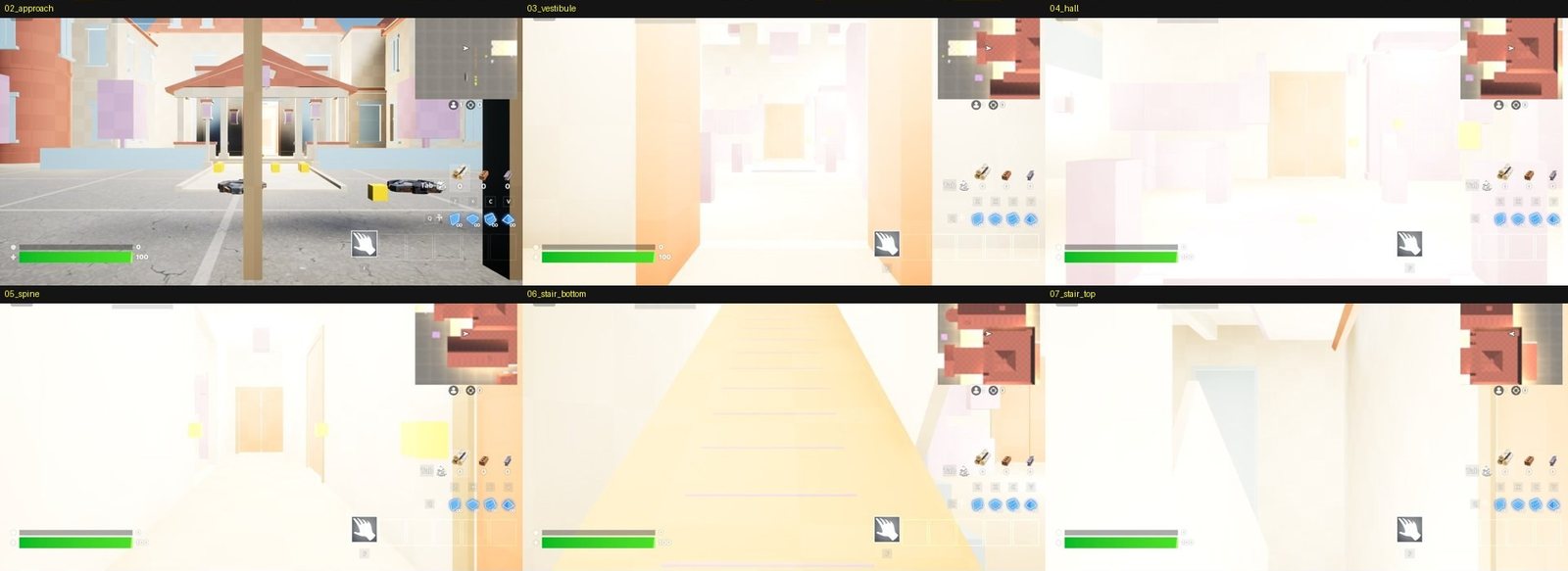
I asked for the house from a game idea I had a while back to be rebuilt in a new UEFN project as plain gray boxes first. Four players, first person, art later. A script placed about 2,500 simple pieces from measurements, so the plan could be rebuilt at another scale by changing one number.
The first test taught me something a floor plan could not. A Fortnite player’s eye sits about 176 cm up, roughly a fifth taller than the child I had sized the rooms around, so the same house felt smaller. That afternoon a second script swapped the boxes for pieces from a purchased Victorian mansion kit.
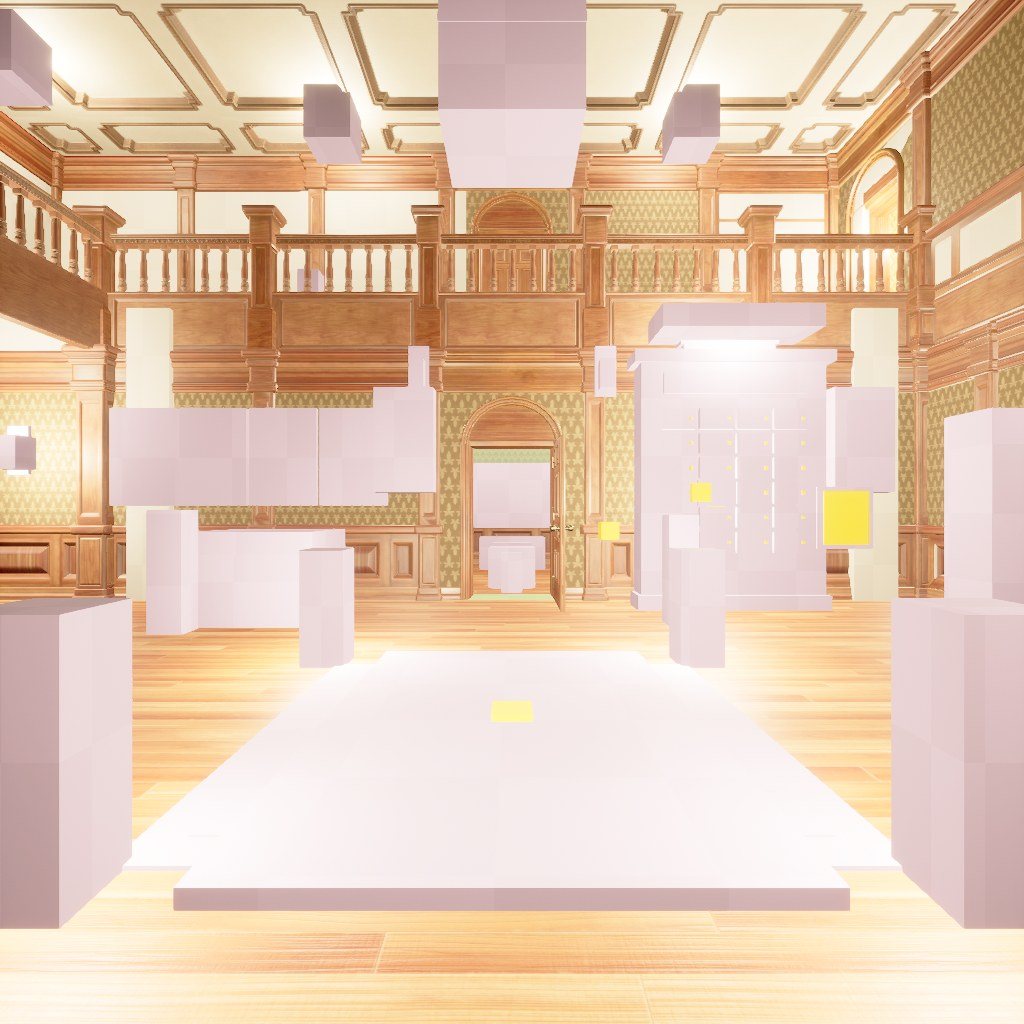
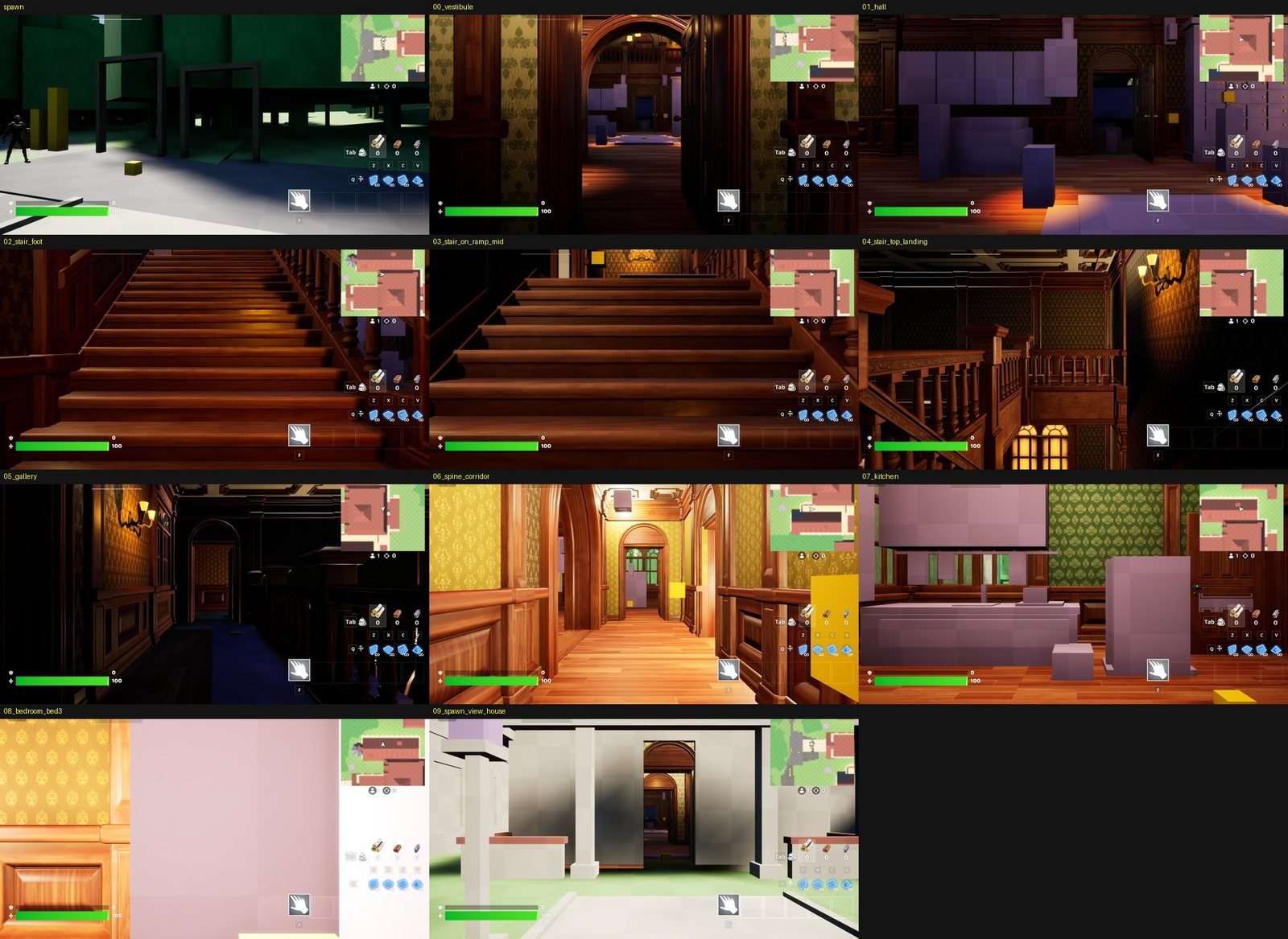
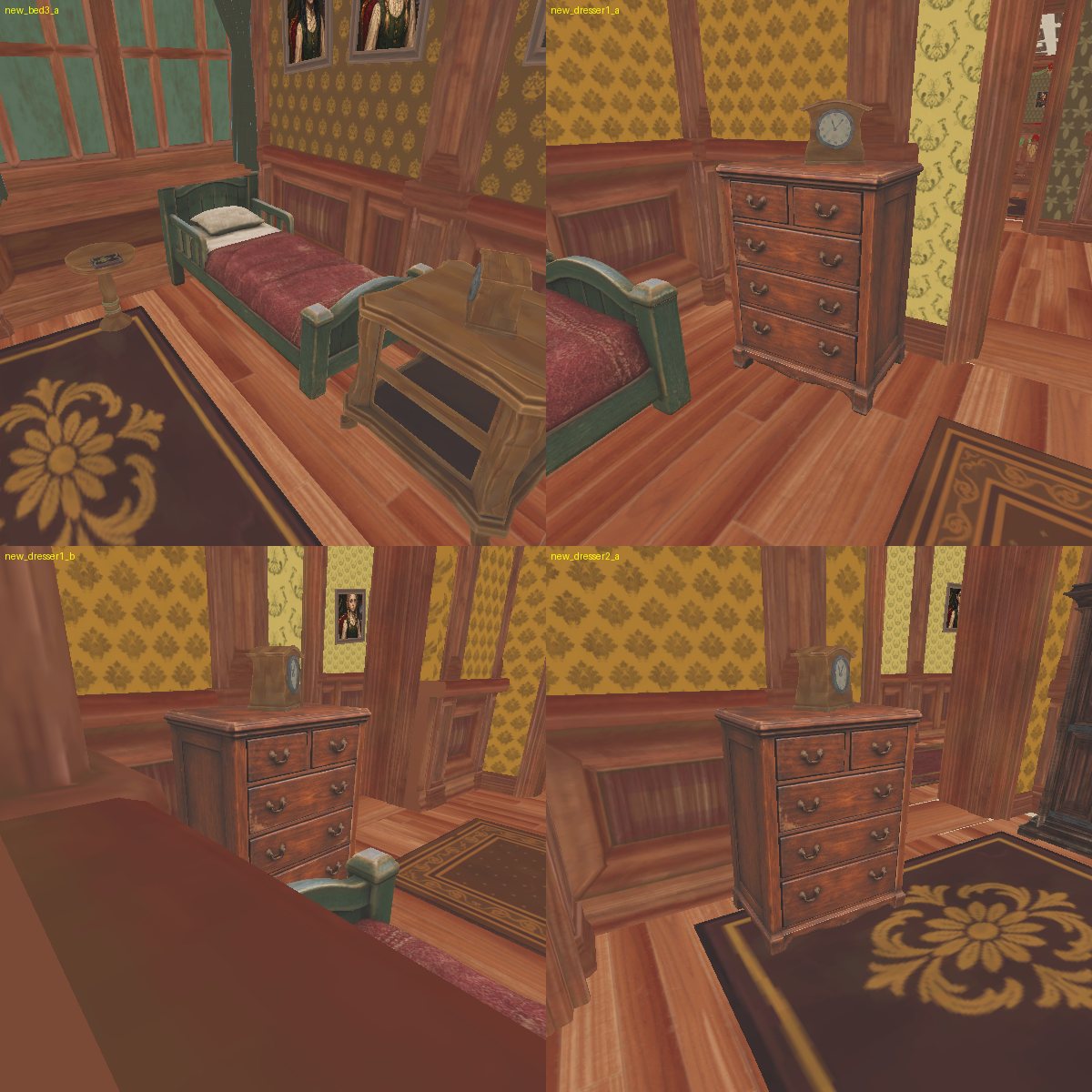
The kit house was running in Fortnite, with pale blocks standing in for furniture. It was a one-player tour by teleport, not a walk-through. Over the next three days the blocks gave way to dressed rooms, and on the last day a generated bed, chair and dresser replaced pack furniture.
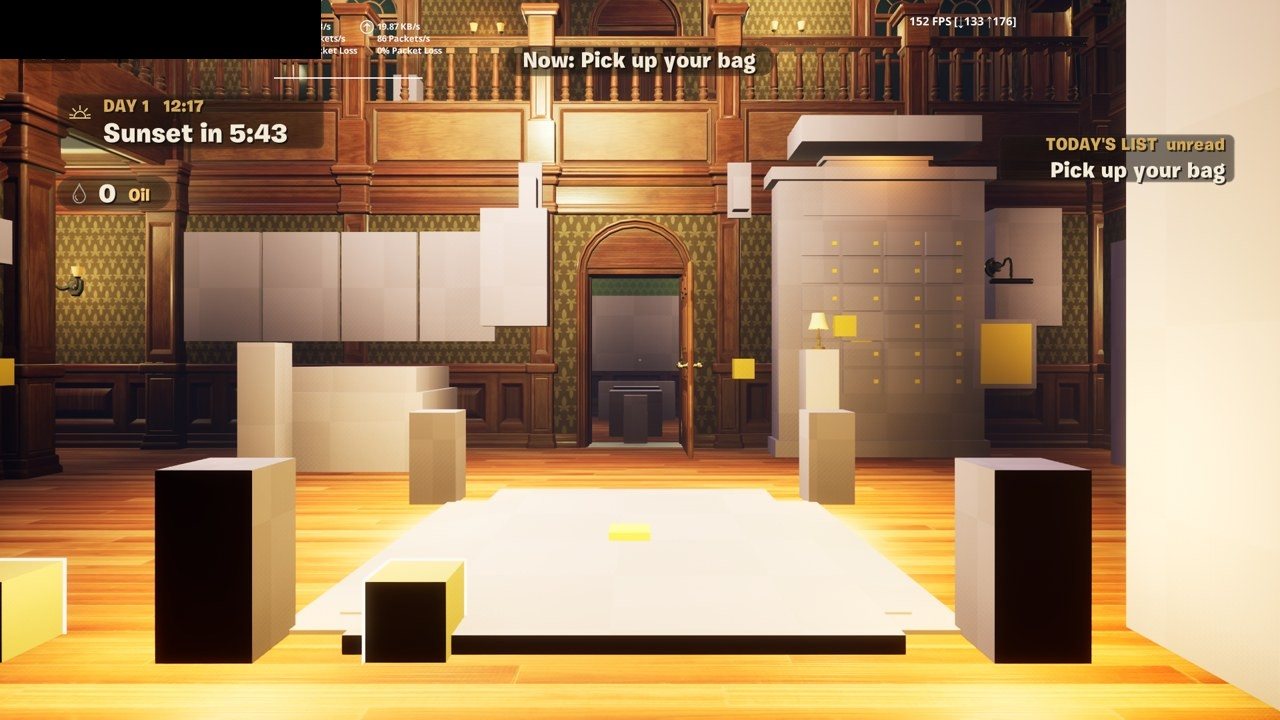
Fortnite runtime test The gray-box house seen in the running game, with Fortnite’s stock display still on screen. One player.UEFN editor Editor render of the hall after the swap to kit pieces. The pale blocks are stand-ins for furniture.Fortnite runtime test The first tour of the kit house in the running game. One player, moved between stops by a test script.UEFN editor Editor views of the generated bed and dresser that replaced pack furniture. Not a gameplay capture.
Chapter 09
Too bright, then too hazy
The house looked right in the editor and wrong in the game, more than once.
The first lighting pass put 52 lights where the earlier layout had lamps. At full strength every room washed out to white in the running game. At a fifth of that strength the rooms could be read.
“the lighting needs to be insanely moody and dark, and whatever we’re doing is the opposite of that.”
My direction, recorded during development.
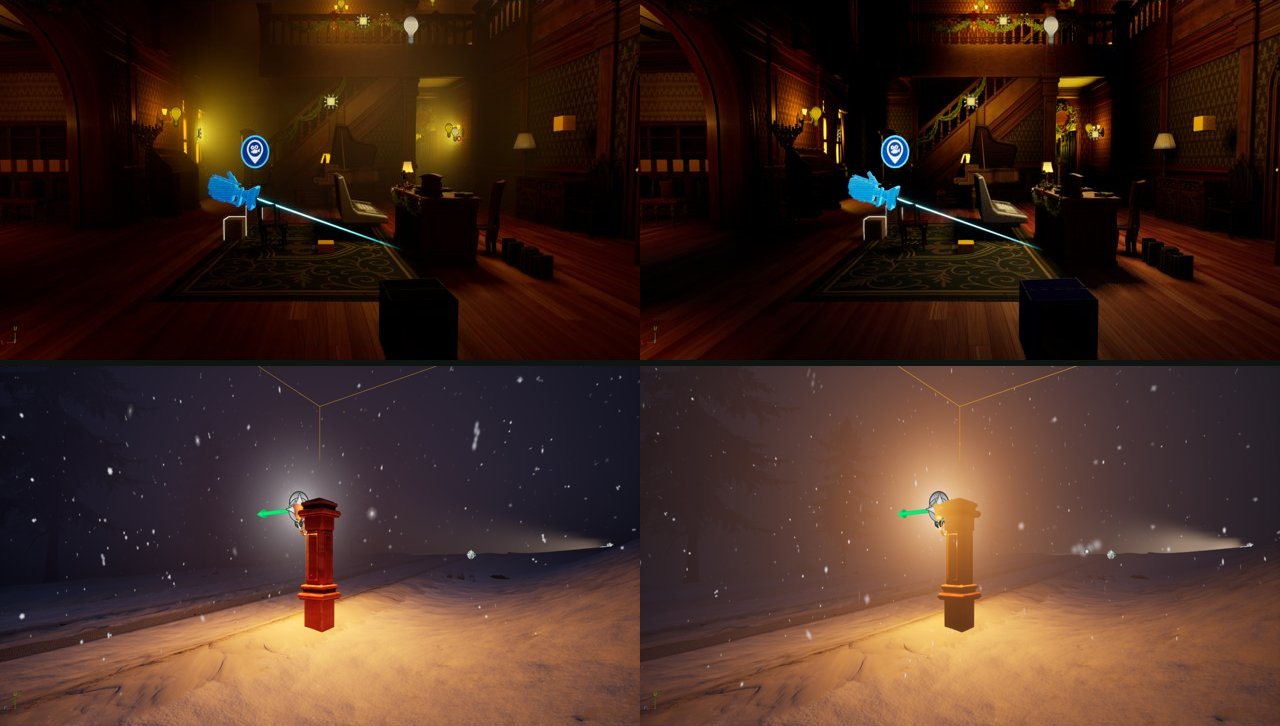
I saw a creamy haze indoors that the editor did not show. The outdoor fog was filling the rooms, and the room lights lit it up. The fix was a fog material that knows where the rooms are. That result was checked in the editor first.
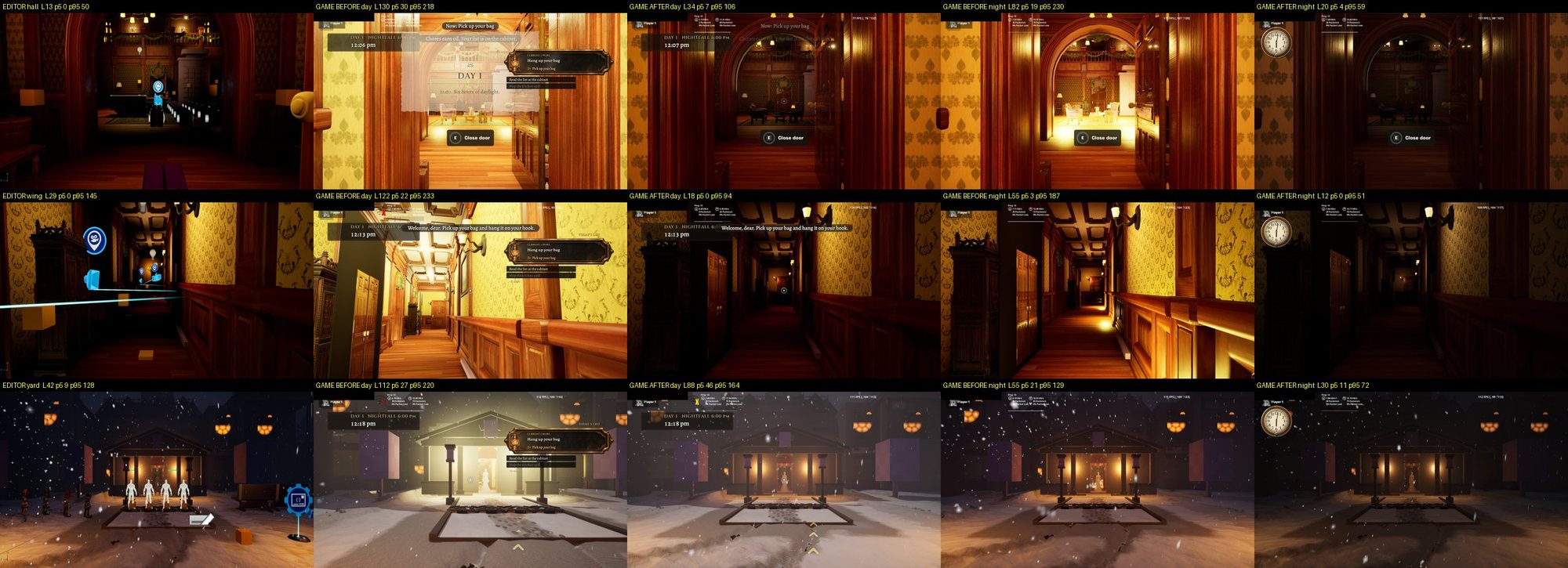
A day later the game still looked flat. A side-by-side measurement found 62 extra room lights that the game’s code switched on at the start, plus automatic exposure. With those off and the exposure locked, the hall dropped from 130 to 34 by day on a 0 to 255 scale. That evening I took over the lighting direction, and on the last day I placed lights by hand.
Fortnite runtime test The gray-box tour with the lights at full strength: the interiors are white. One player.UEFN editor Editor viewport, before on the left and after on the right: the hall clears while the lane lamp keeps its glow.UEFN editor and Fortnite runtime test Left to right: the editor, the game before and the game after, by day and at night. The numbers in the labels are measured brightness.
Chapter 10
A prompt only when it helps
One hold-to-use pattern had to serve every chore, lamp, bed and clue.
I wanted players to understand what they could touch without the screen shouting at them. The first version showed a prompt only when the player was in reach and facing the object. In the test it appeared at 2.3 metres and not at 6.5.
The first run got it wrong: a prompt showed up 7 metres away. Right after a teleport, the game still reported the player’s view from the old spot, so the eye position is now worked out from the character. A wall check could not see the house’s walls, so reach and facing do the job.
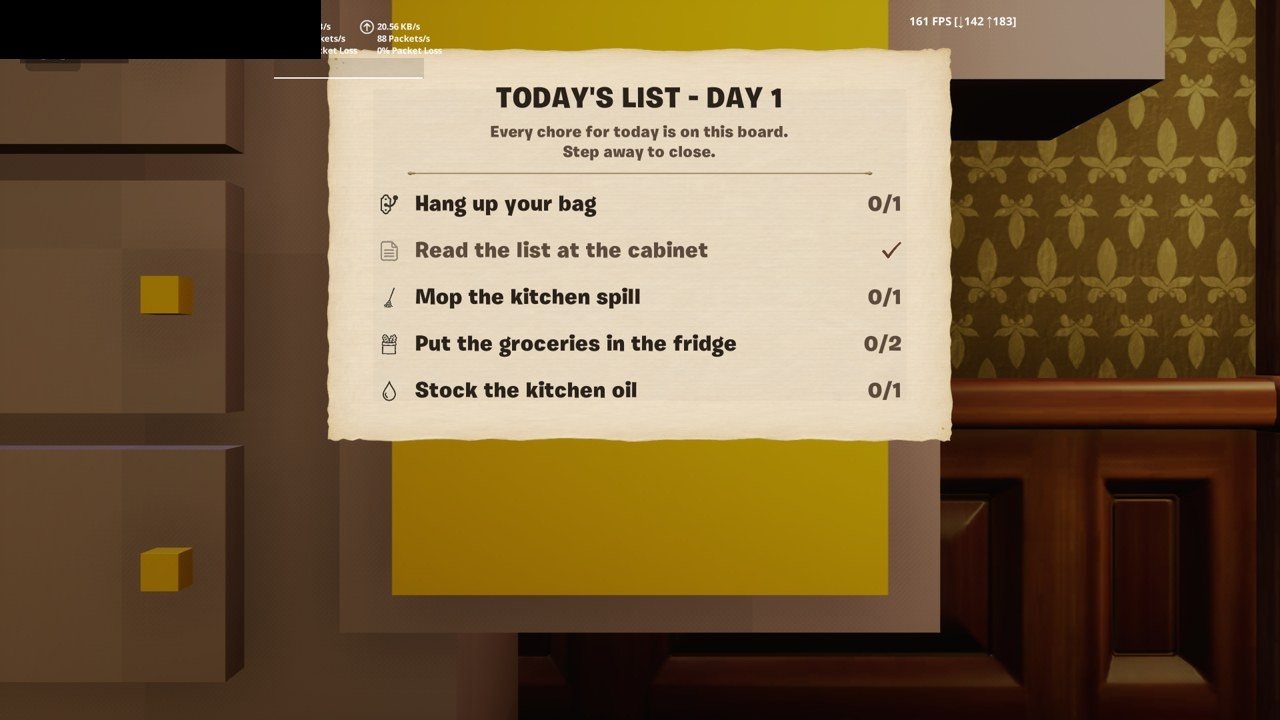
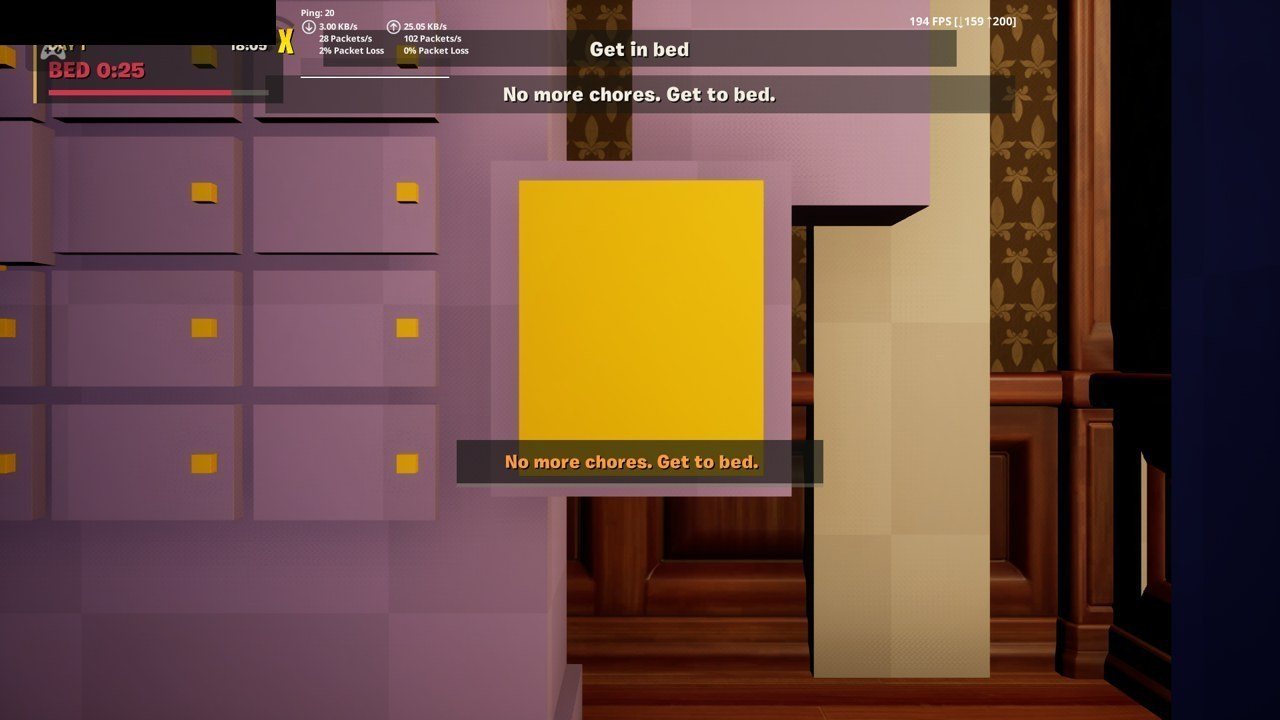
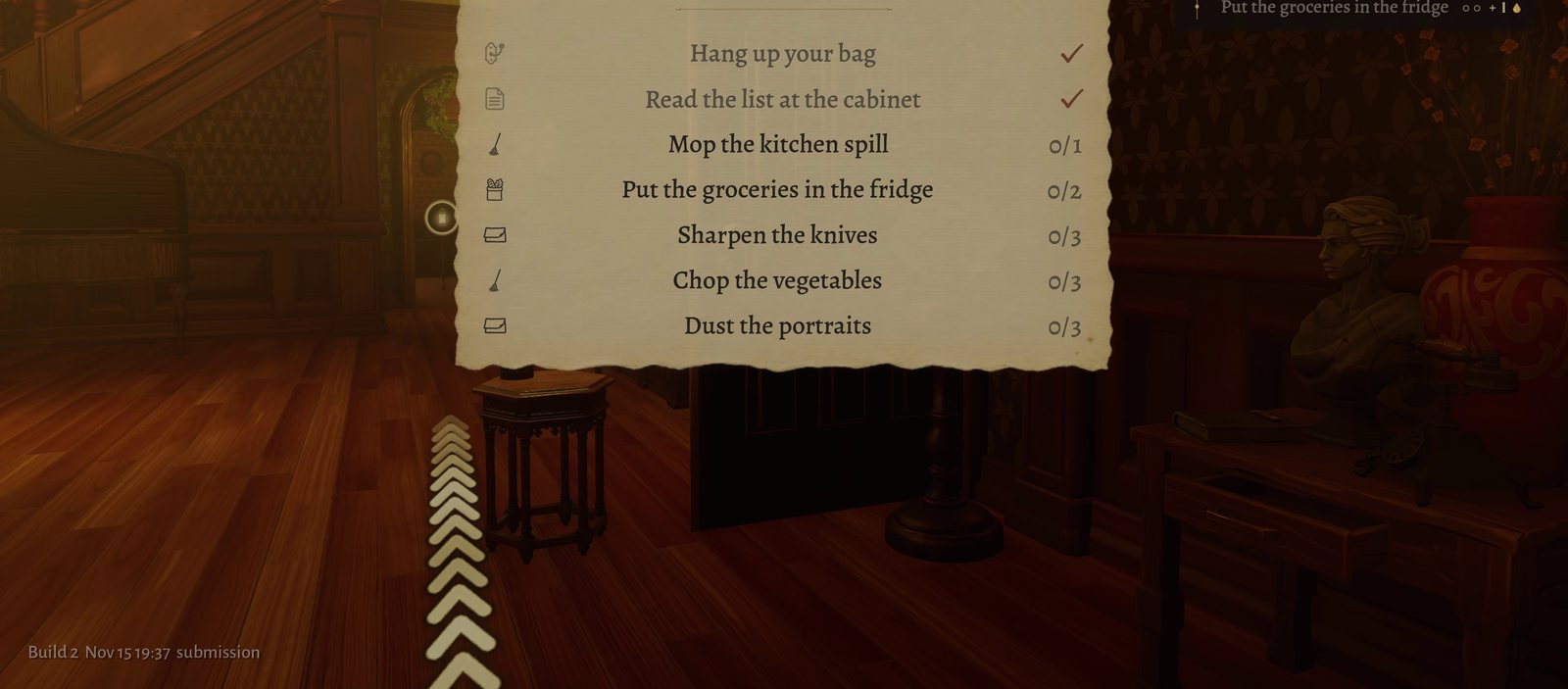
Holding the key at the cabinet opens the chore list on a sheet of paper. Trying a chore after the bell brings a refusal: “No more chores. Get to bed.” These were keyboard tests with one player. On the last day testers still found lamps with no prompt, so I count this as improved, not solved.
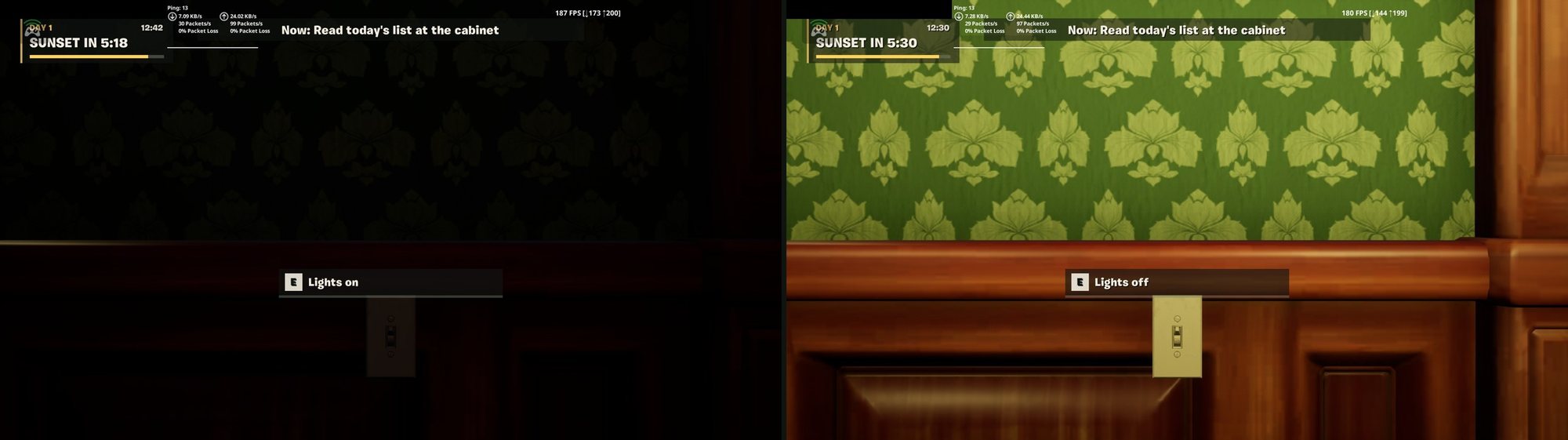
Fortnite runtime test The same wall switch before and after holding the key: the prompt changes from “Lights on” to “Lights off”. Early interface. I later replaced the switches with oil lamps.Fortnite runtime test The chore list opened at the cabinet in the running game. One player. The black box masks an account corner.Fortnite runtime test The bedtime refusal on the early stand-in interface. One player. The black box masks an account corner.
Chapter 11
Less on the screen
A horror game should not keep a dashboard between the player and the dark.
The first interface kept dark plates on screen all the time: the day, a countdown, a fear score and the oil count. It worked, and it sat between the player and the house. I rejected opaque panels for play.
“things that are fully opaque should not be on the screen. I know it looks pretty, but it really doesn’t work in horror games.”
My direction, recorded during development.
The rebuilt interface shows almost nothing at rest. The day, the clock, the objective and the oil appear when something changes or when the player holds Aim, then fade. Paper and brass are kept for the chore list, the day cards and the prompts. Three presets cover Immersive, Accessible with larger text, and Classic with the full display.
The before and after frames are from the running game with one player. The presets and hold-to-recall are described in the build notes, and I have no record of them being judged in a playtest. Later I removed the fear score and added a small build number for testers.
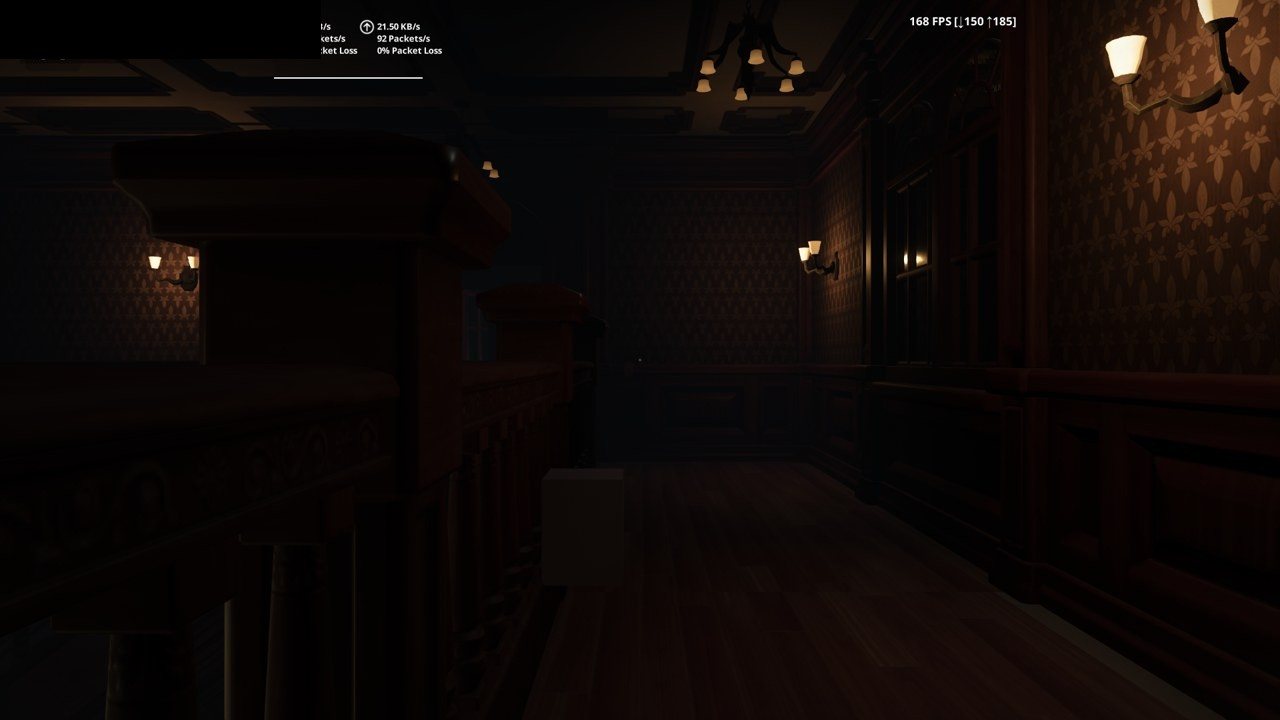
Fortnite runtime test Before. The standing display at bedtime: plates and banners over the corridor. One player.Fortnite runtime test After. The upstairs gallery at rest: nothing on screen but the test overlay. One player.Fortnite runtime test Holding Aim brings back the day, the clock, the oil and the current chore for a moment. Stand-in furniture blocks are still in the hall.
Chapter 12
The arrival
Before players touch the controls, the house should already feel far from anywhere.
I wanted the game to open in a vehicle at night: snow, fog on every side, no sky, and one warm light ahead. My first idea was to seat all four players in a real Fortnite truck and let them look around. Three quick tests kept returning the passenger to Fortnite’s camera behind the vehicle, so I changed the approach.
“I need much more fog int his game when the car is driving. its too visible--not quite scary enough”
My direction, recorded during development.
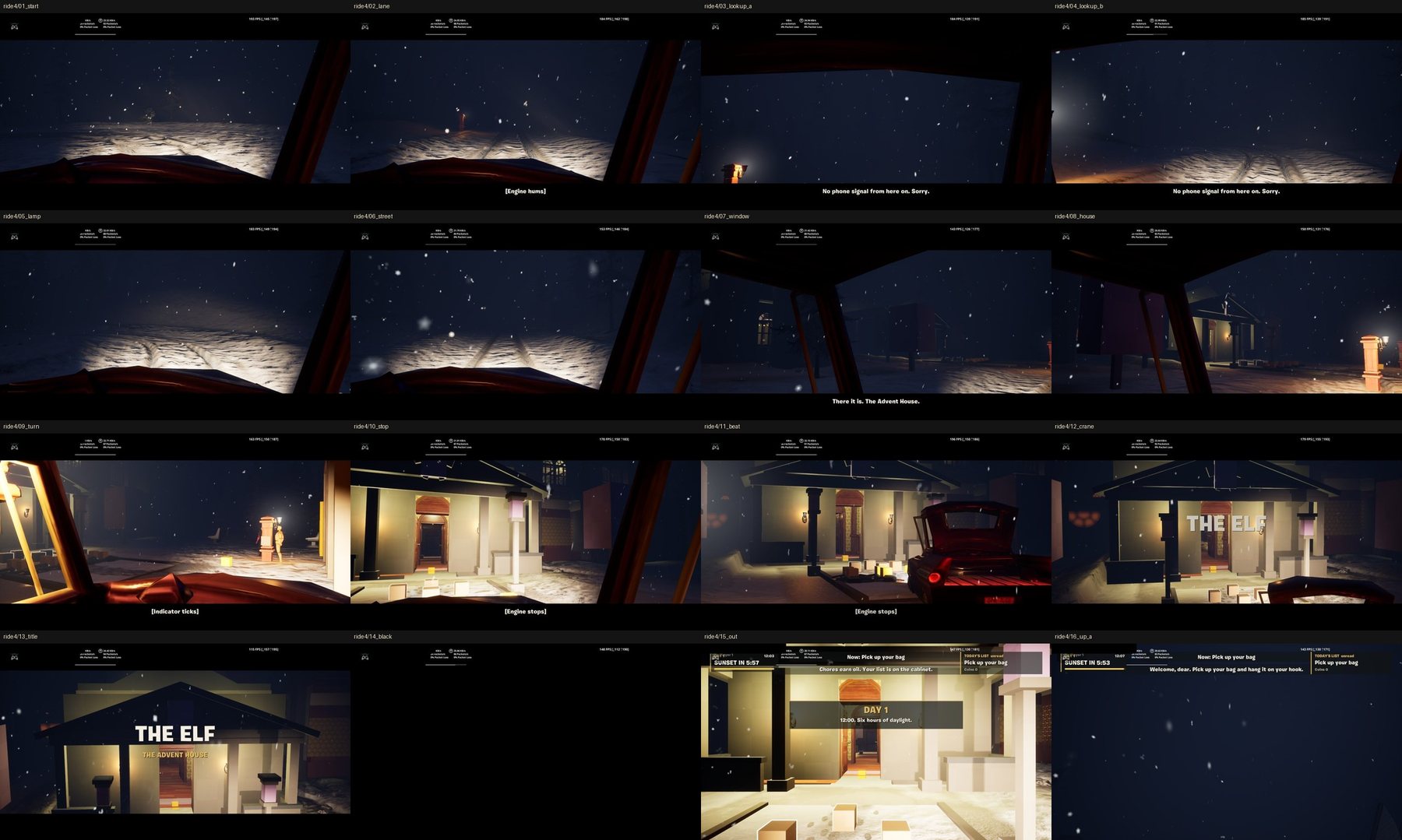
So the ride became a directed film. The first version ran in the game: headlights on the ruts, a lamp passing, the house appearing, a title, then control at the front door. The porch was still blocks and the vehicle a stand-in.
By the last day the intro lived in one Sequencer timeline with a purchased vehicle model, a driver with recorded lines, the intro song I supplied and a painted logo. One problem stayed open: on a cold start the intro could skip ahead, and I recorded it with a workaround.
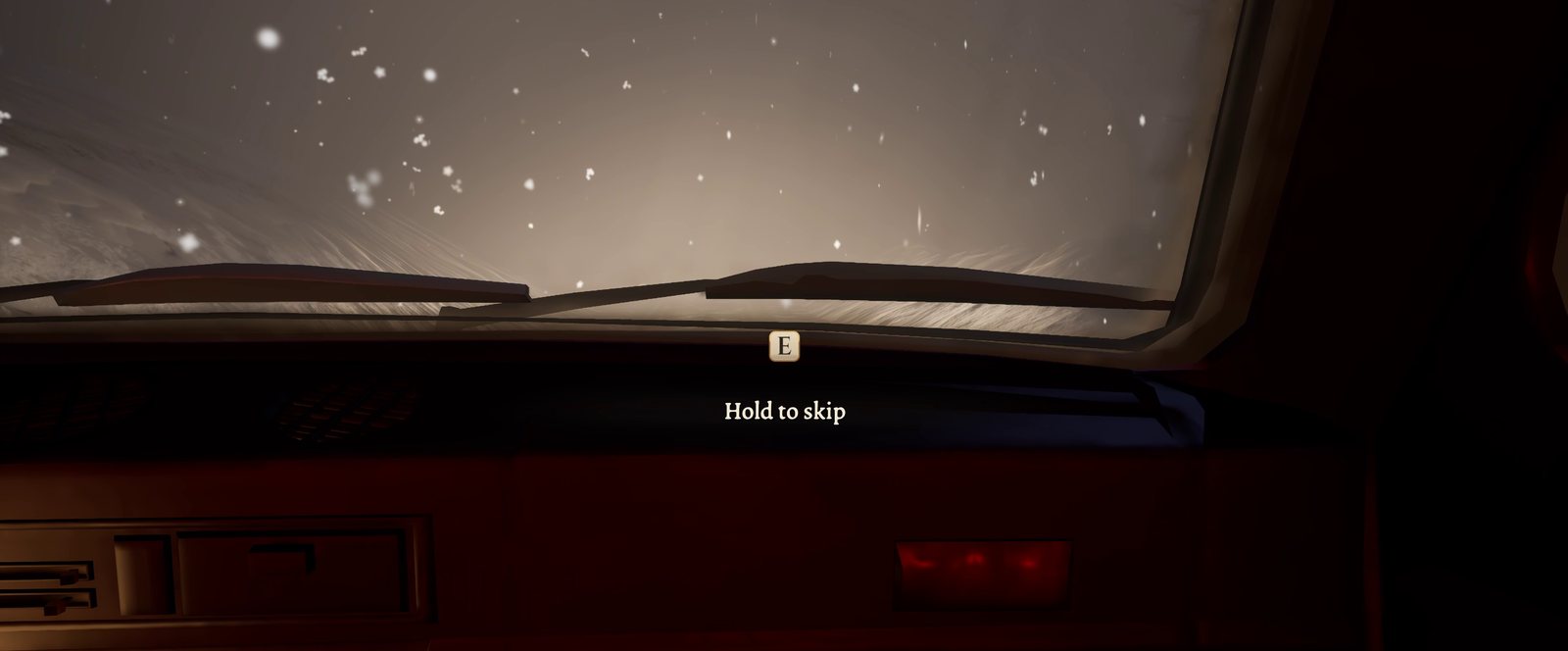
Fortnite runtime test The first version of the ride in the running game, stop by stop: block porch, stand-in vehicle, early title. One player.Fortnite runtime test The cab view from my final-evening development recording. Cropped to the picture. One player.Fortnite runtime test The front doors in the headlights, from the same recording. Cropped to the picture.Fortnite runtime test The title card over the front doors, from the same recording. Cropped to the picture.
Chapter 13
A toy that moves when nobody looks
The whole game rests on one rule, so the rule had to be tested from every doorway.
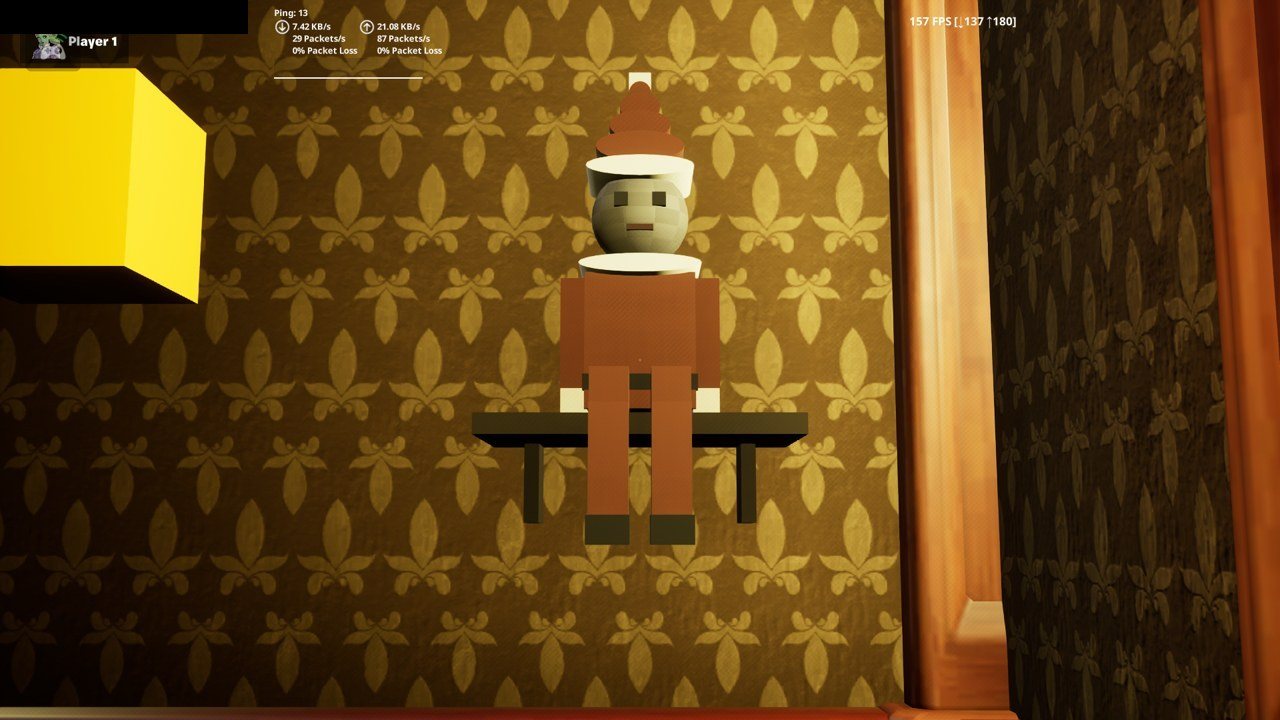
The idea is simple: the elf only moves when nobody is watching. The first version was a blocky stand-in doll on a shelf. Four times a second the game checked who could see it, through open doorways but not through walls or shut doors. Fifteen watched cases behaved as expected, with one real player.
“i dont want the player ever to see the elf until the first night”
My direction, recorded during development.
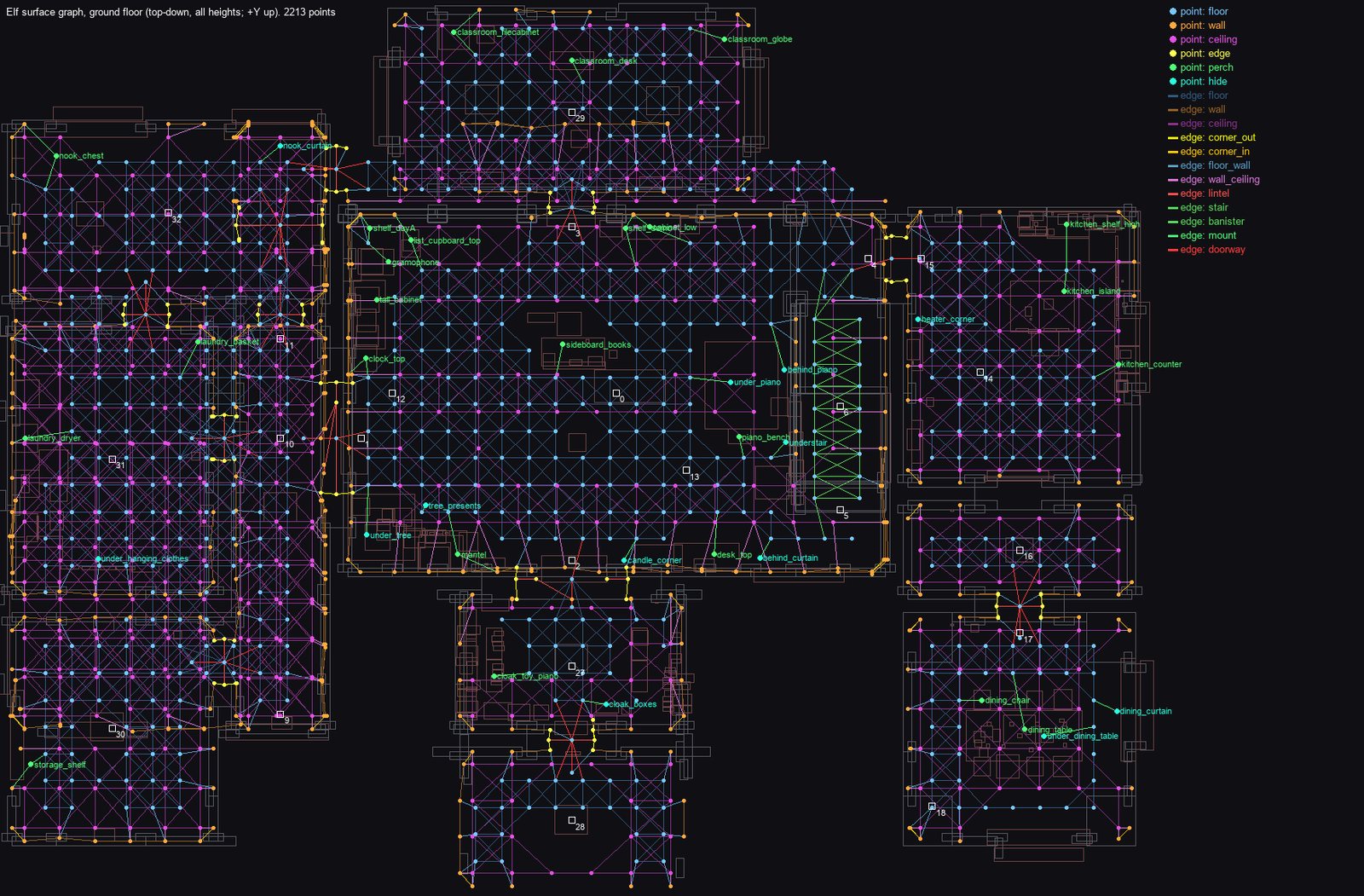
Then I asked for more character. It should sit where a toy would sit, drop in a heap just before you look, and climb walls and ceilings. The agent mapped the house into 2,839 points so it could find routes while unseen. The falls were simulated once and baked into animation.
Later the elf learned to stay out of lamp light. I also split it in two: a cute elf on the shelf by day, and the creepy long-fingered one for the scares. In the last playtests people rarely saw it, so I asked for it to be larger and its bell louder. I have no playtest record of that final tuning.
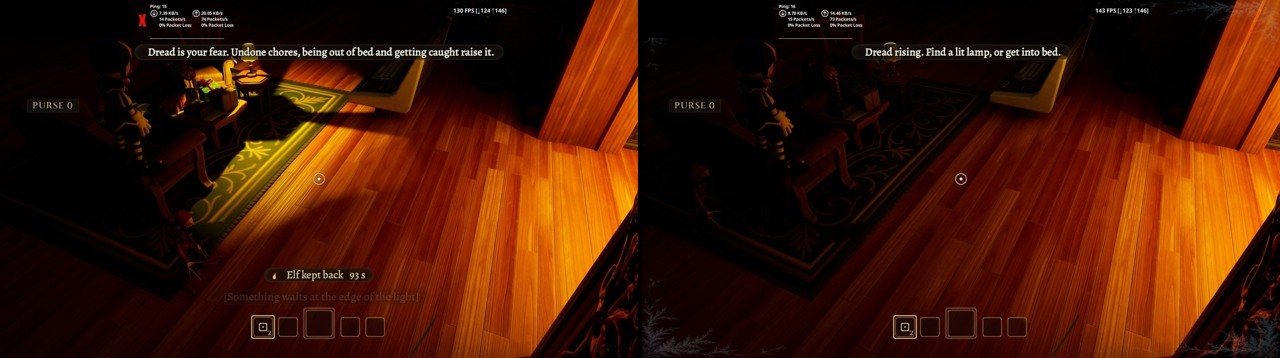
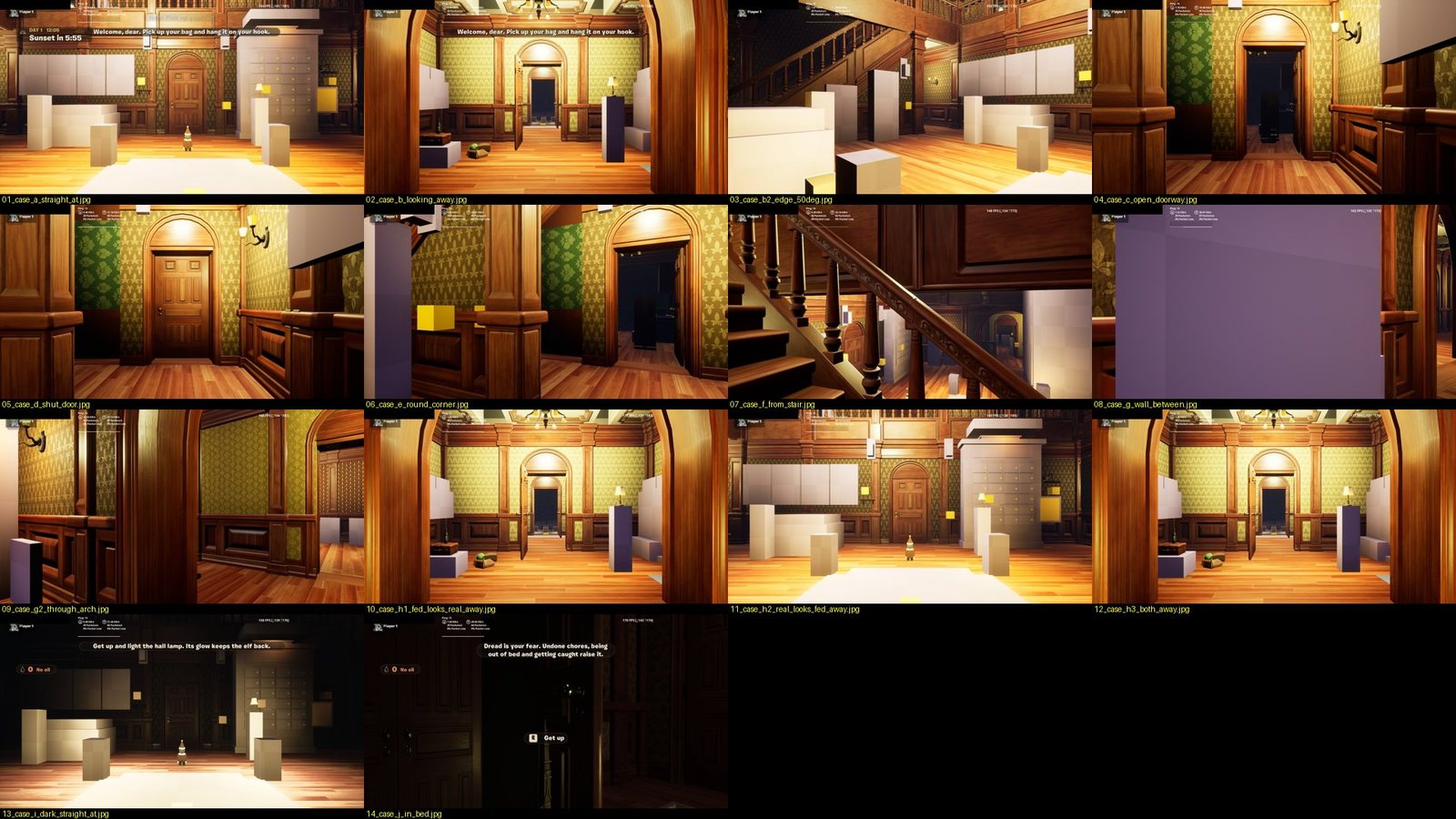
Fortnite runtime test The first stand-in doll on its shelf in the running game. One player.Diagram The elf’s map of the ground floor: floors, walls, ceilings, door frames and perches. A diagram, not game footage.Fortnite runtime test A self-running test with a fixed camera. Left: the lamp is lit and the elf waits at the edge of the light. Right: the lamp has died.Fortnite runtime test The cute elf seated on the hall mantel on day 1. Running game, fixed test camera, one player.Fortnite runtime test Every watched case from the first test: straight at it, looking away, through a doorway, a shut door, from the stair. One player.
Chapter 14
The threat reaches Fortnite
The strongest handoff is a behavior seen inside the target game.
Blender prototype
Directing the scare before rebuilding it
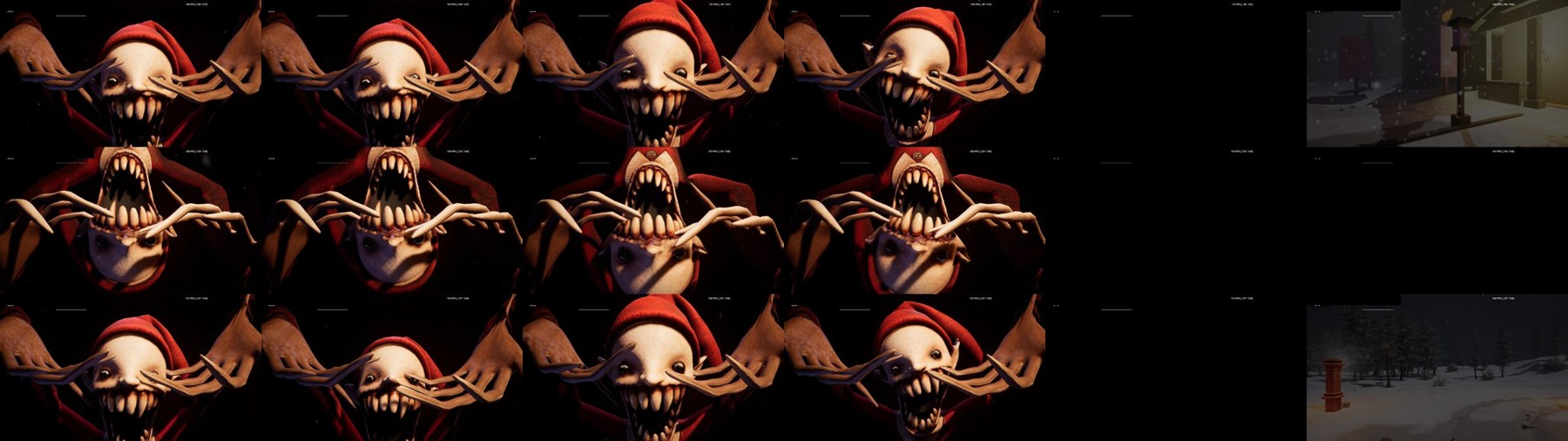
I asked the agent to bring the evil elf into Blender and build a short cinematic: crying in a dark room, turning toward the camera, then attacking. The first pass blended the supplied crying and running animations into a roughly thirteen-second film with a title card.
“imagine his fingers kind of grabbing the edges of the camera and shaking it and then him biting you.”
I wanted less room and more dread. I asked for the opening to be barely visible, the attack to happen faster, and the logo and end sequence to go. Then I pushed the contact further: fingers around the edges of the camera, a shake, and a bite into black. The revision made the change from distant movement to an intimate threat the point of the scene.
0:08 • Blender cinematic prototype
My selected scare clip: a nearly invisible opening, a rush into the lens and a cut to black. Blender prototype prepared as a reference for UEFN Sequencer.
Inside the Blender scene
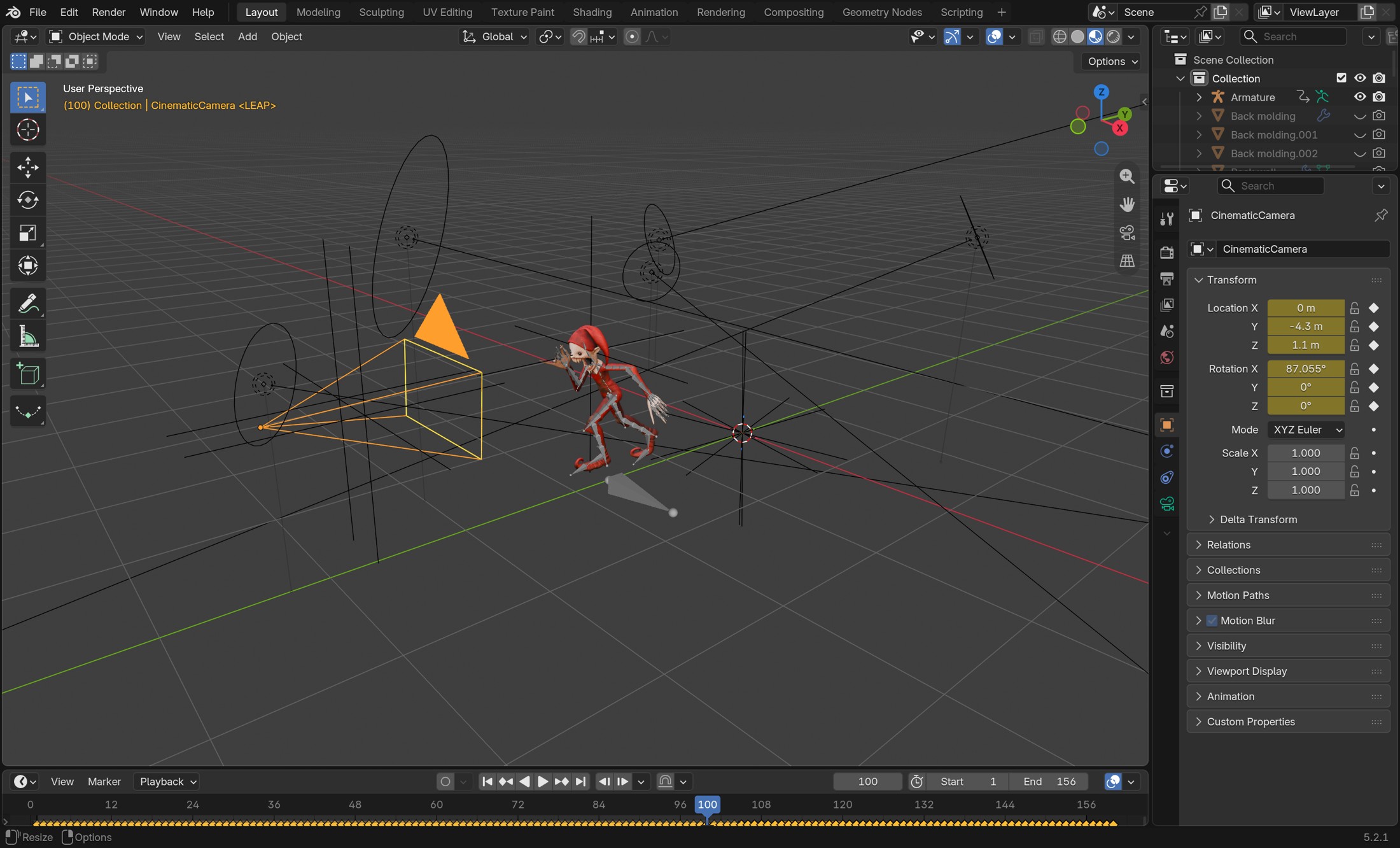
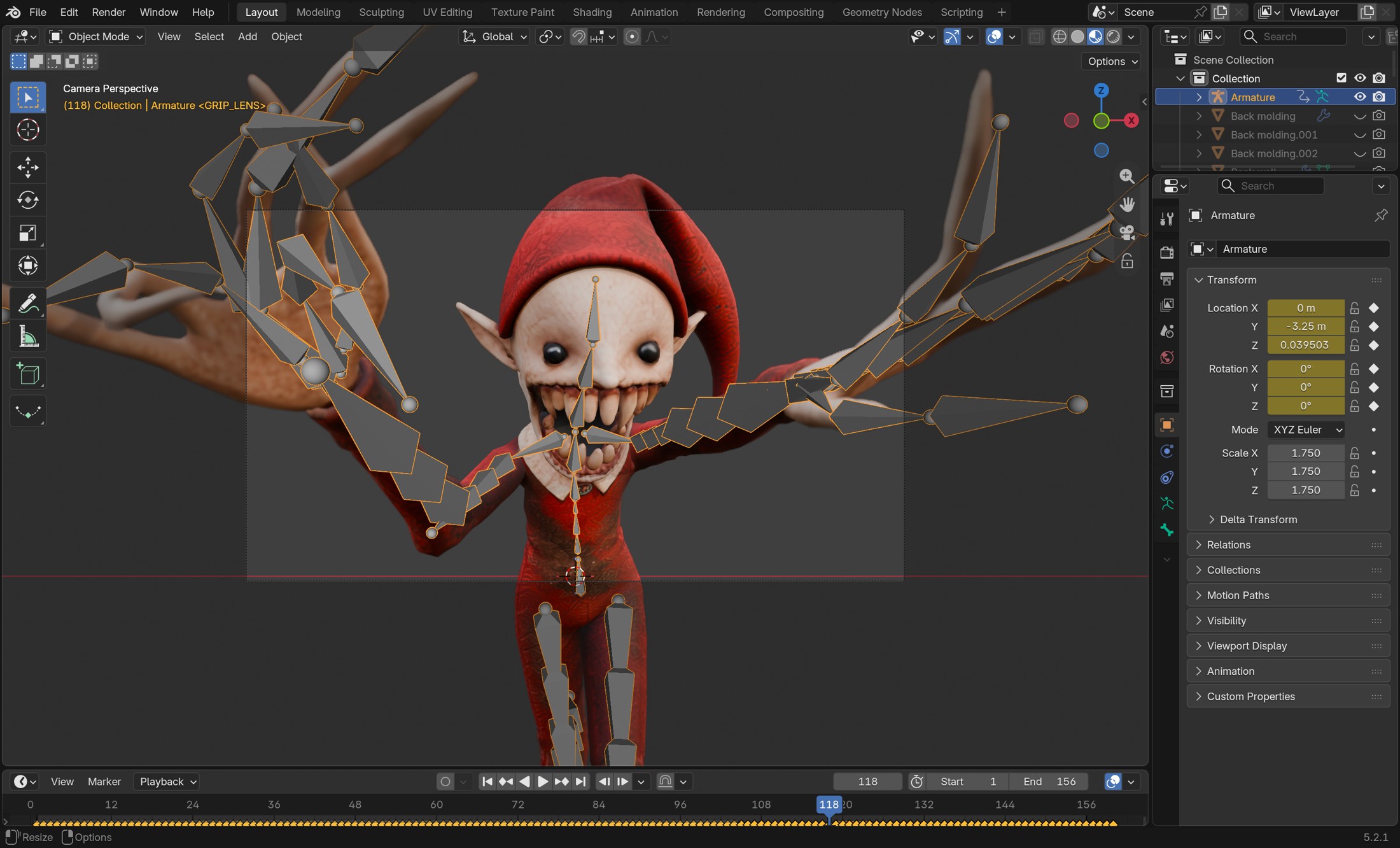
The saved scene breaks the performance into named beats: shadow cry, turn, charge, leap, lens grab, shake and bite. These views were captured by reopening that scene for this documentary. The brighter material preview exposes the rig and staging that the finished lighting conceals.
Blender scene inspection The leap at frame 100. The camera, light guides and animated character show how the rush was staged. Set dressing is hidden in this inspection view.Blender scene inspection The lens grab at frame 118. The skeleton and camera boundary reveal the hand placement behind the close-up. This is a material-preview inspection, not the final lighting.
I asked for the video, editable Blender scene and a handoff prompt to be copied to Windows so the other agent could rebuild it in UEFN. The package included the original rig and animation clips, textures, soundtrack and timing notes. I could point to a performance instead of trying to describe every beat again. This was a visual target for the Sequencer rebuild, not a recording of the finished game.
The encounter inside Fortnite
The Windows development record captured a major step: the elf moved along the house’s surfaces, waited above a player and triggered a close-up scare. The retained clip shows the ceiling encounter, the attack and the return to the house in a scripted one-player test.
The behavior had to fit both the decorated house and Fortnite’s limits. A route search tried to do too much at once and stopped the game scripts, so planning was spread across frames. A dedicated room, camera and animation sequences staged the scare; exposure and HUD changes made the close-up readable.
This was the moment the visual idea became a recognizable event in Fortnite. I could then ask better questions: what does each player see, does the elf respect attention and light, and does control return reliably? I have kept both the result and the limits of that test in this story.
UEFN runtime test Development capture: three scare tests in the running game with one player and scripted views. Historical test evidence, not the final submitted snapshot.
Chapter 15
Sound I could judge by ear
The agent measured the sound files; I judged how they felt.
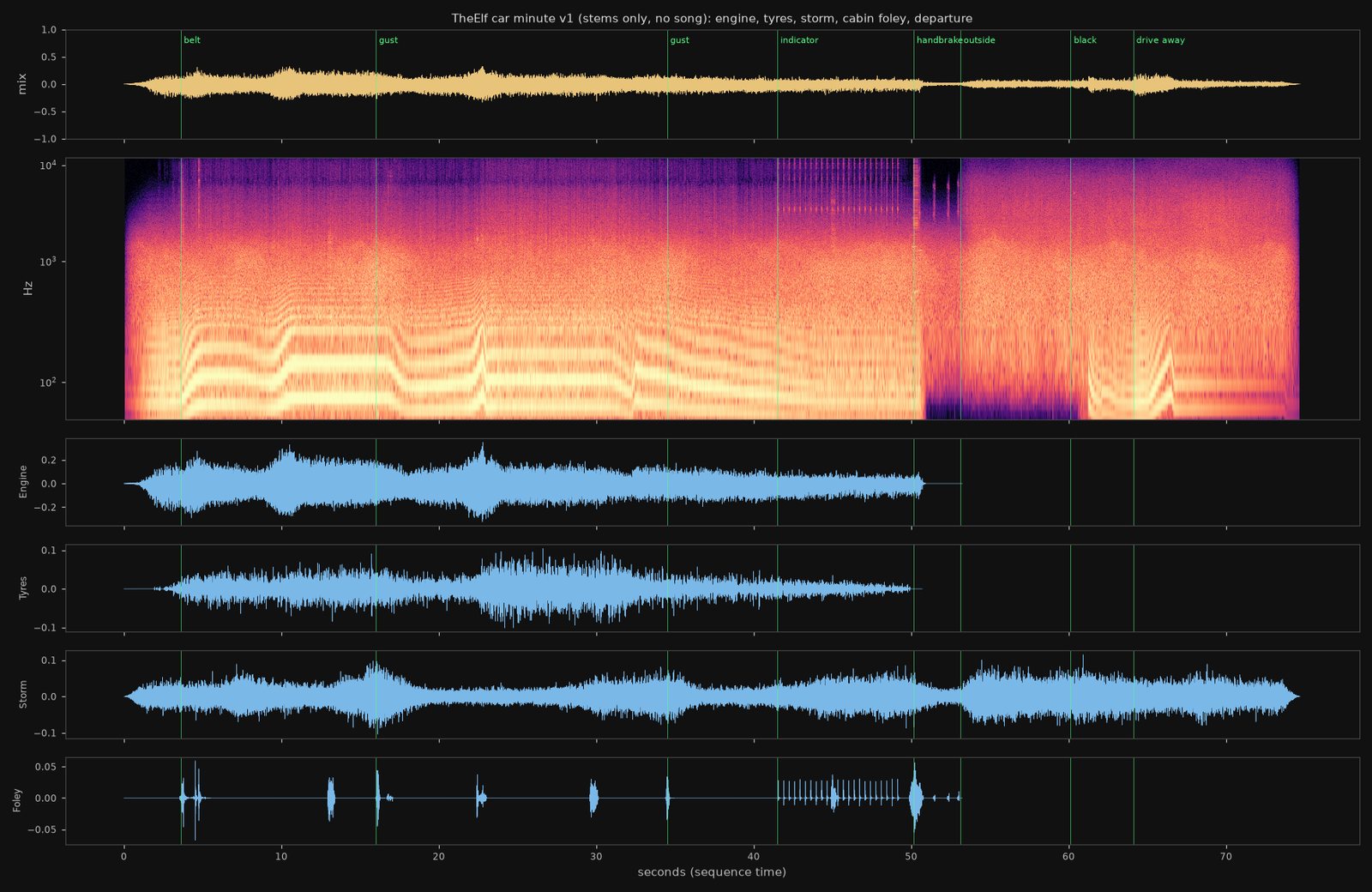
I asked for a proper mix: a muffled engine in snow, the storm outside, creaking boards. There were no car, bell or creature recordings on the PC. The agent indexed about 4,900 sounds from packs I had bought and used measurements to shortlist candidates for me to hear.
“You should just feel very remote and lonely.”
My direction, recorded during development.
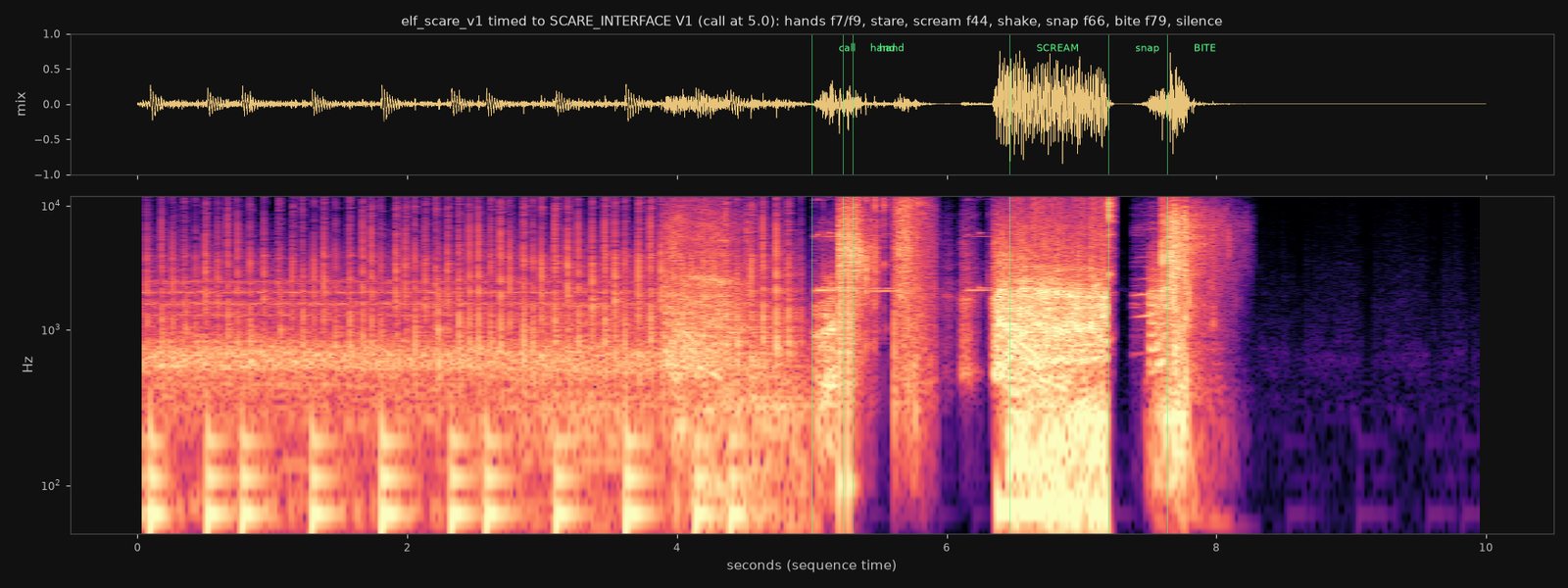
The arrival and the elf were built from pack recordings of snow footsteps, wood, cloth and monster voices, plus synthesized parts: an engine that follows the ride’s speed, a small bell with slightly wrong notes, and taps that differ on a floor, a wall and a ceiling.
I played the previews on my studio monitors and approved them. That was an offline audition, not sound heard in Fortnite. The 57 sounds were then imported and wired to the elf’s behaviour. For this implementation, the tonal choices were baked into the sound files before import.
Offline audio render The car minute as separate layers: engine, tyres, storm and cabin details. An offline render, not a recording from Fortnite.Offline audio render The jump scare scored to the animation: chase, grab, scream, bite, silence. An offline render, not a recording from Fortnite.
Chapter 16
Four masks and a heavier Matron
Expanding the cast meant checking what the generators actually delivered.
Each player is a child in an elf costume with a wooden mask. I asked for four different expressions, oversized, with wooden ears attached. The first was fitted. Three more were generated in Tripo from four reference views each, at about 10,000 triangles.
“So make four completely different elf expressions, you know? Kind of like almost like clowns.”
My direction, recorded during development.
For this prototype, each player controls a separate animated figure while the underlying player character is hidden. Ghost copies in the empty slots let me see four elves run down the stair with one person playing. On the last day a two-player test showed jitter. The fix went in, and I locked the result.
The Matron changed most. My heavier model arrived from a 3D generator with a rig that opened gaps at the neck, wrists and hem. Overnight it was welded into 52 parts, given its own 92-bone skeleton and taught eight moves. At the end her face still looked blurry to me in the cutscene.
External preview The three downloaded mask models rendered in Blender. A source preview, before fitting in the game.External preview Blender render of the new Matron on her own skeleton, holding out both hands. Not a game capture.
Chapter 17
Giving the Matron a voice
On the last evening the characters finally spoke.
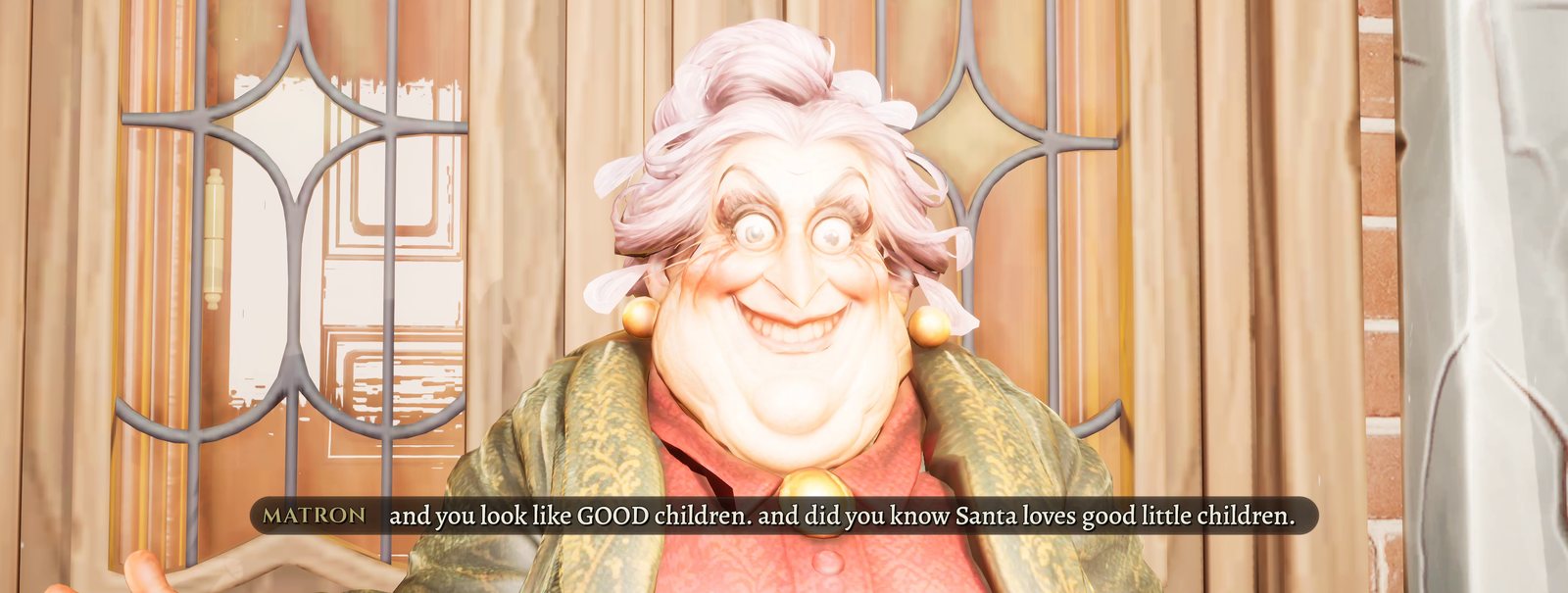
I wrote the Matron’s welcome line by line. On the final evening I gave the agent the list of eight lines with their timings. It generated them through the ElevenLabs API, trimmed them, imported the sound files and placed them on the cutscene’s timeline at the frames I had set. That went in minutes before the submission build.
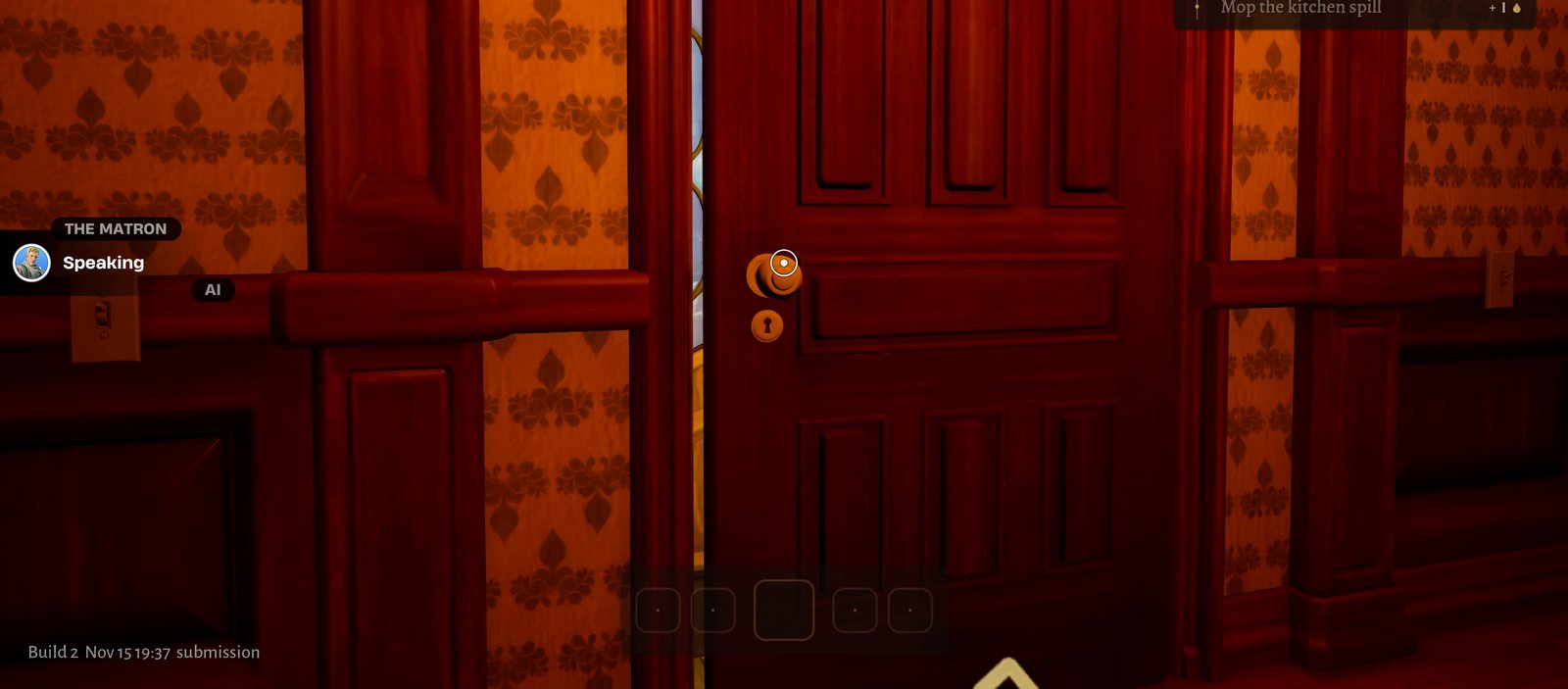
For her lines around the house I used Fortnite’s own AI character tools. The agent set up a hidden character with a written personality and a built-in voice. When one of the Matron’s captions appears, that character is asked to say exactly that line. In my recording a small panel reads “The Matron, Speaking, AI”.
It was a first attempt, built that afternoon. I had planned an AI voice for the driver too, then chose recorded lines for her. On one tester’s build the Matron was silent, and the speaking panel remained visible in the recording. I kept this as a prototype with an unresolved playback issue.
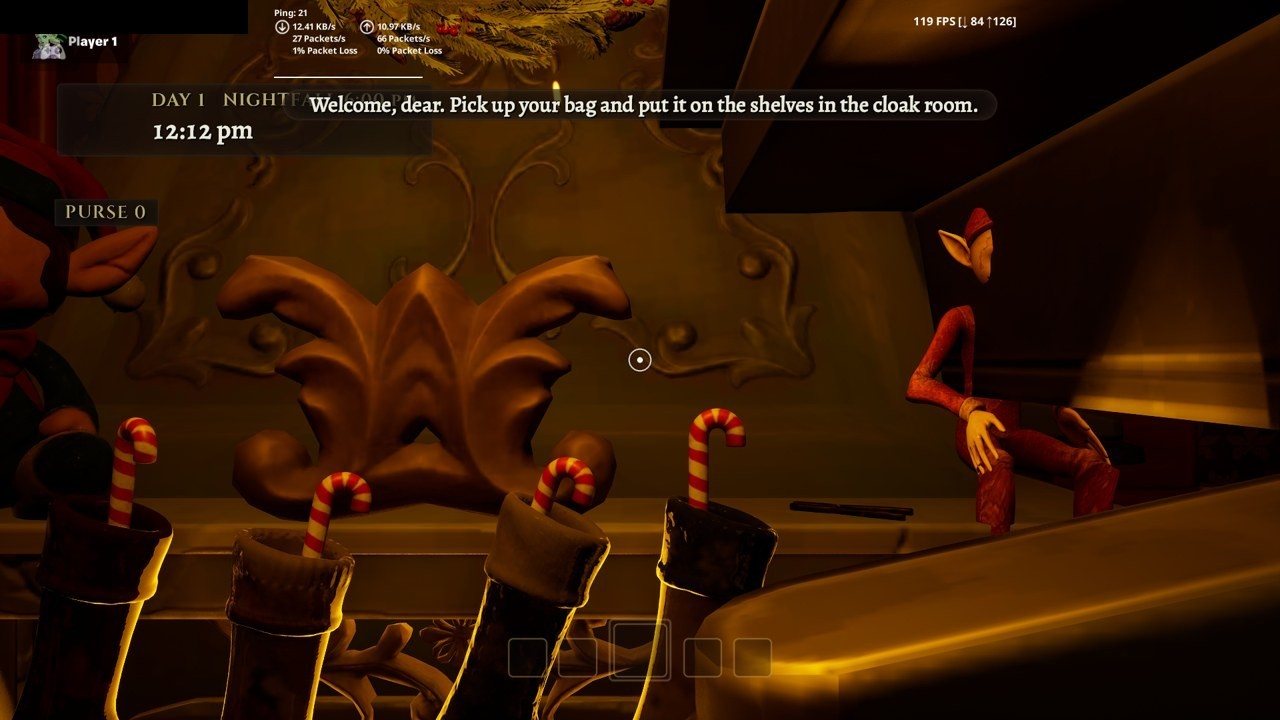
Fortnite runtime test The Matron’s welcome from my final-evening development recording, with its subtitle. Cropped to the picture.Fortnite runtime test During play, the panel at the left shows Fortnite’s AI voice speaking as the Matron. Same recording, one player. The build stamp is at the lower left.
Chapter 18
Two gigabytes
Several times the game simply would not start, and each cause was ordinary.
This project hit a 2 GiB session-upload limit. New room dressing pushed the upload to 3.1 GB and nothing could launch. Almost all of it was textures stored at 4K. A script shrank 132 of them, and the upload passed at about 1.9 GB without removing a prop.
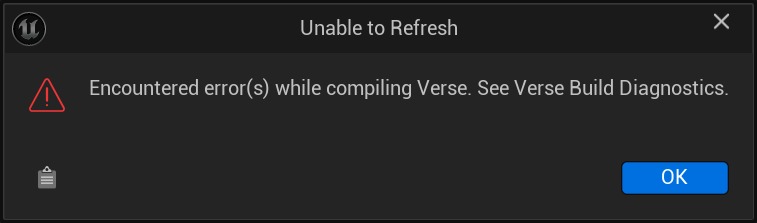
Other stops were stranger. A helper script made a content folder called Lamps, and the game stopped compiling, because in UEFN a folder name is also a code name and that word was taken.
The shrinking had a cost later. A texture reduction checked in from a second PC flattened the snow ground, and eight textures had to be restored on the last morning. Small fixes, but together they decided whether anyone could play at all.
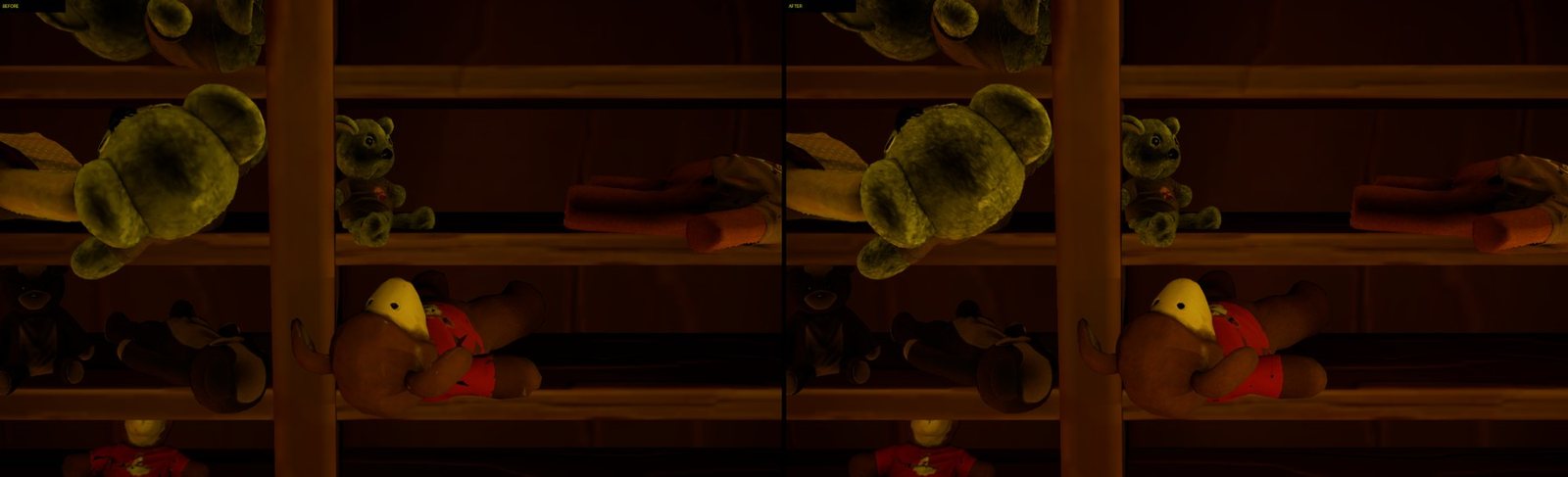
UEFN editor A toy shelf in the editor before and after its textures went from 4K to 2K. The difference is hard to see, which was the point.UEFN editor The editor’s message after a new folder name clashed with existing code.UEFN editor The editor toolbar reading “Project Size: 99%” after three art packs were laid out in the level.
Chapter 19
Oil is the only light
I replaced the light switches with something players have to earn.
The first build had working wall switches and a blackout that rolled through the house room by room. I dropped the switches. I wanted lamps that players fill with oil, so light becomes something the team earns by day and spends at night.
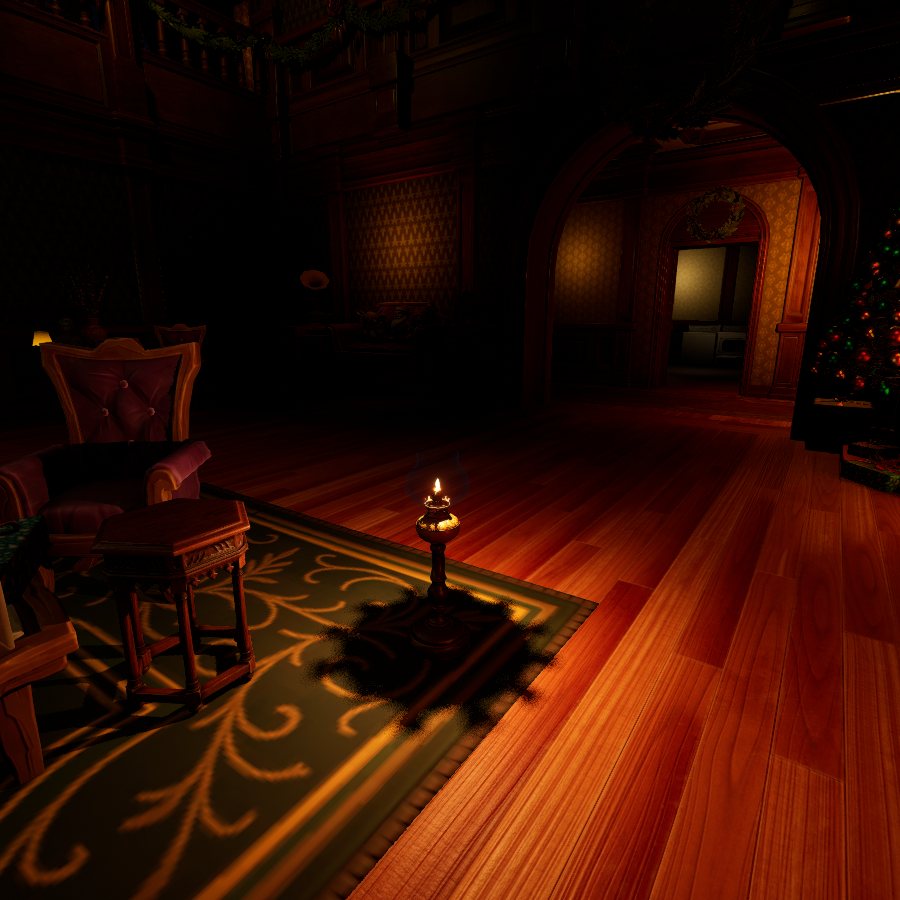
“Then what i want is when its dark its REALLY dark. like 85% dark. and the ONLY thing that is lit are the oil lamps”
My direction, recorded during development.
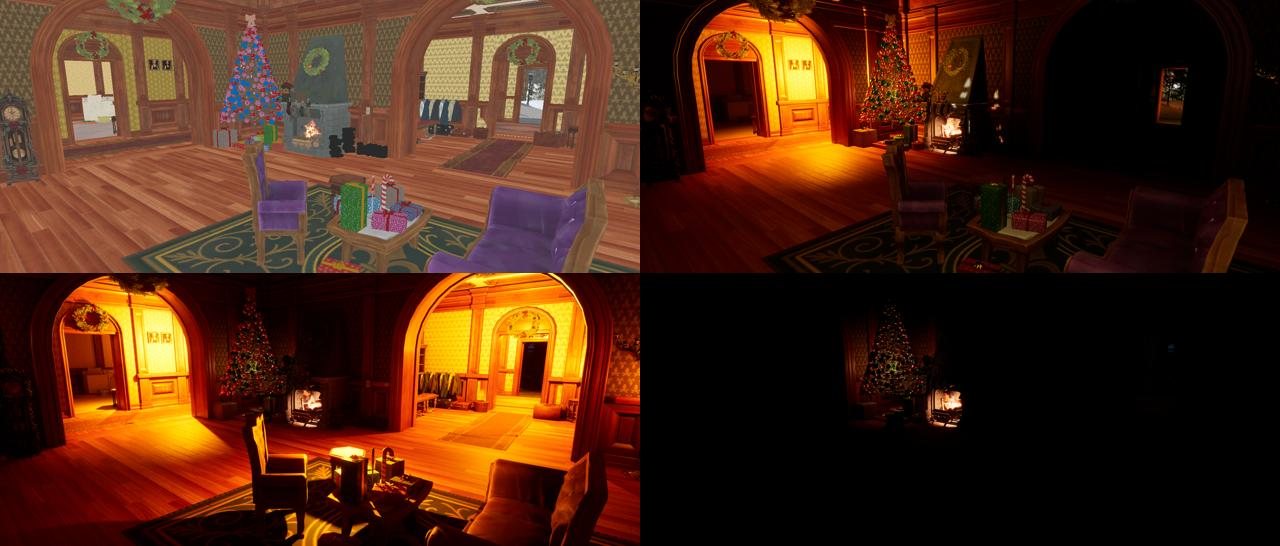
I asked for a late afternoon that fades into a very dark night. One animation the length of a game day now drives the sun, the sky and the house lights. Then every fixture became an oil lamp that burns down, flickers and goes out. Holding oil outlines the lamps you can fill.
Playtests pushed back. On some screens the night was pitch black, and on a PC with shadows switched off the house looked bright, so I ruled that nobody should gain an advantage from graphics settings. On the last day a new floor lamp went in, and I asked for starter oil and soft fill lights. The balance was still being tuned at submission.
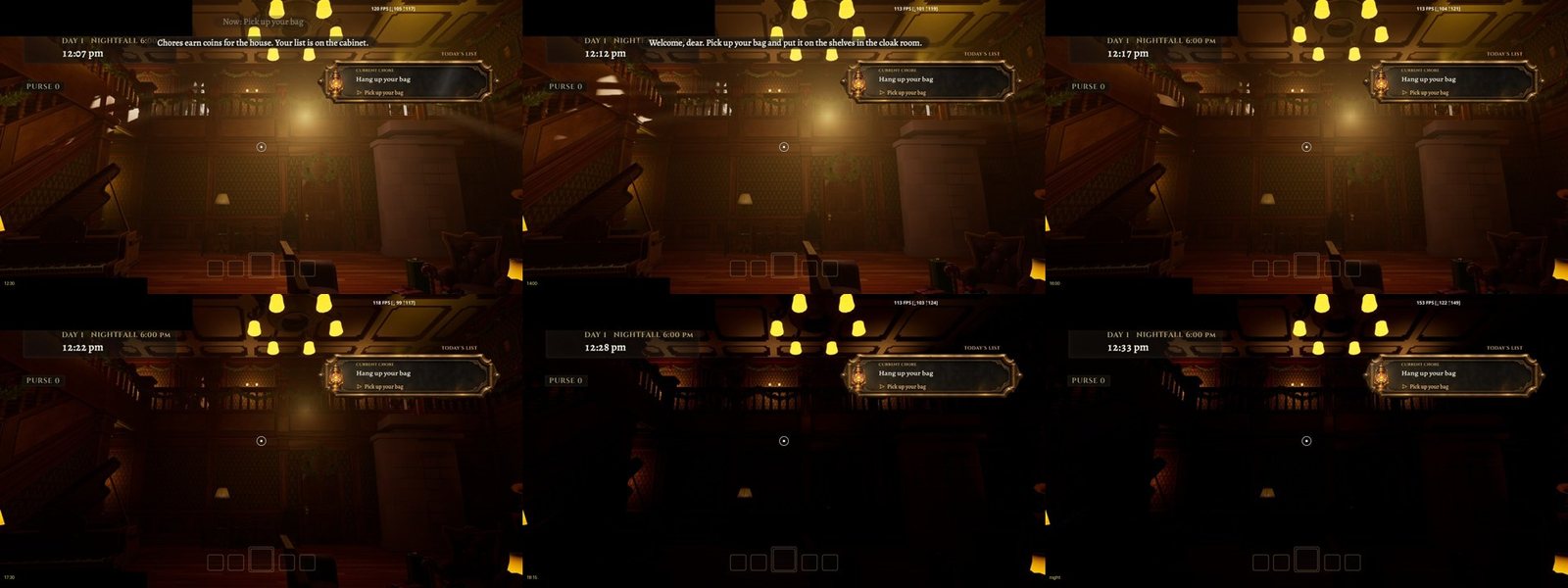
Fortnite runtime test The hall at six game times from 12:30 to night. Running game, fixed test camera, one player. The black boxes mask an account corner.Fortnite runtime test Top: the hall at night before and after the last glowing decorations were switched off. Bottom: one filled lamp in the kitchen and in the gallery.UEFN editor The new floor oil lamp in the hall, lit, in an editor capture. Not a gameplay screenshot.UEFN editor One hall view in four editor previews: working light, day, night with lamps lit and night with lamps out. I asked for these one-click previews to tune the lighting.
Chapter 20
The first five minutes
The opening had to teach chores, coins, oil and fear without a tutorial screen.
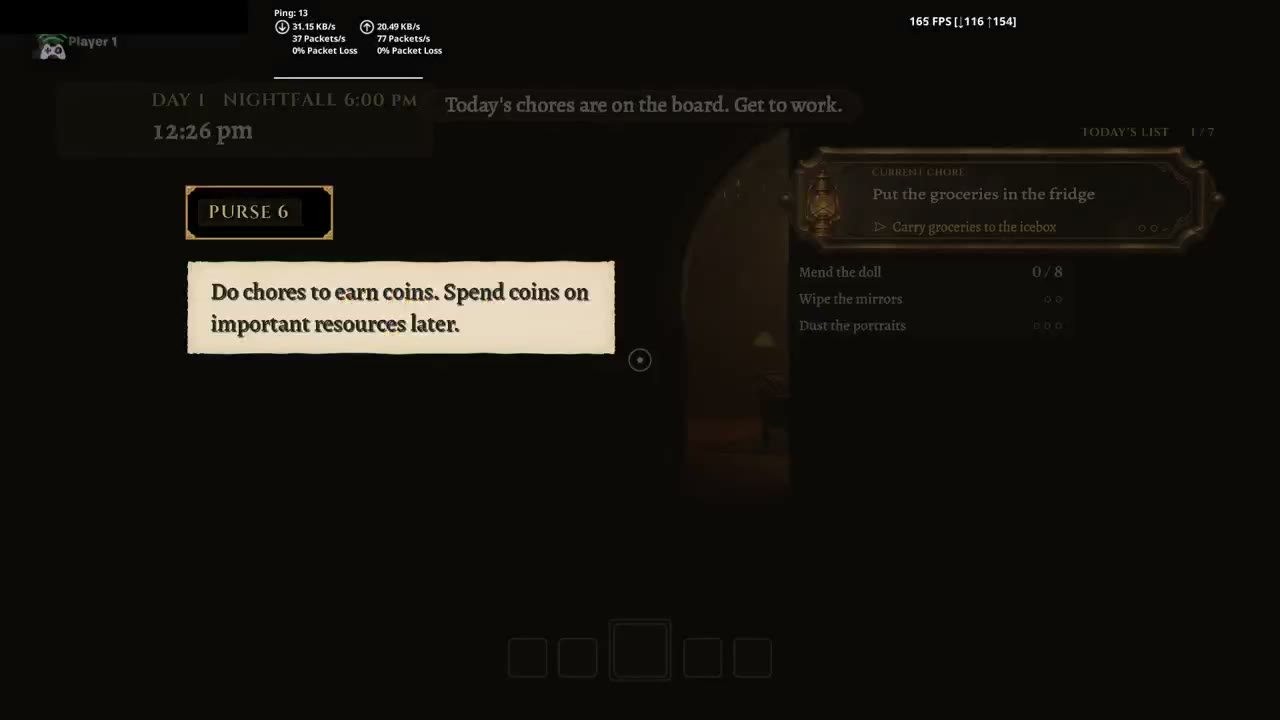
I wrote out the first five minutes beat by beat. Each player gets a different first chore on a paper card. When it is done, a coin flies to the purse and the screen dims around it with one line about earning and spending coins.
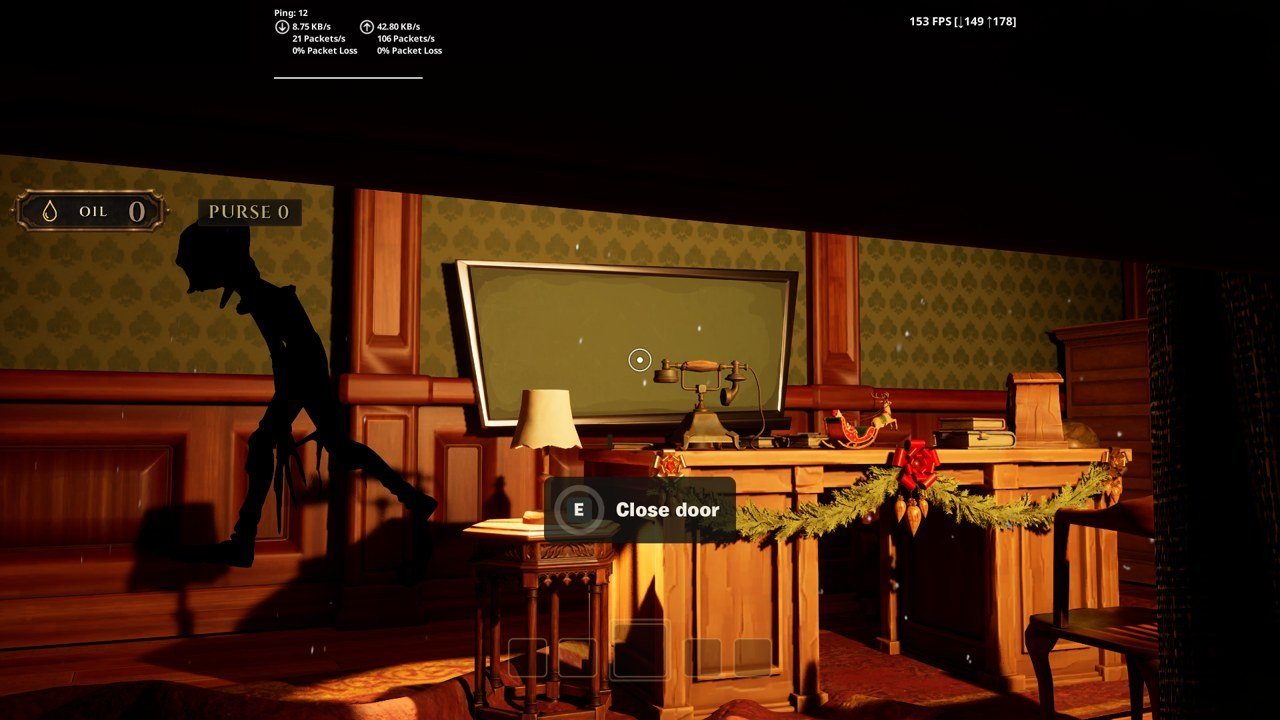
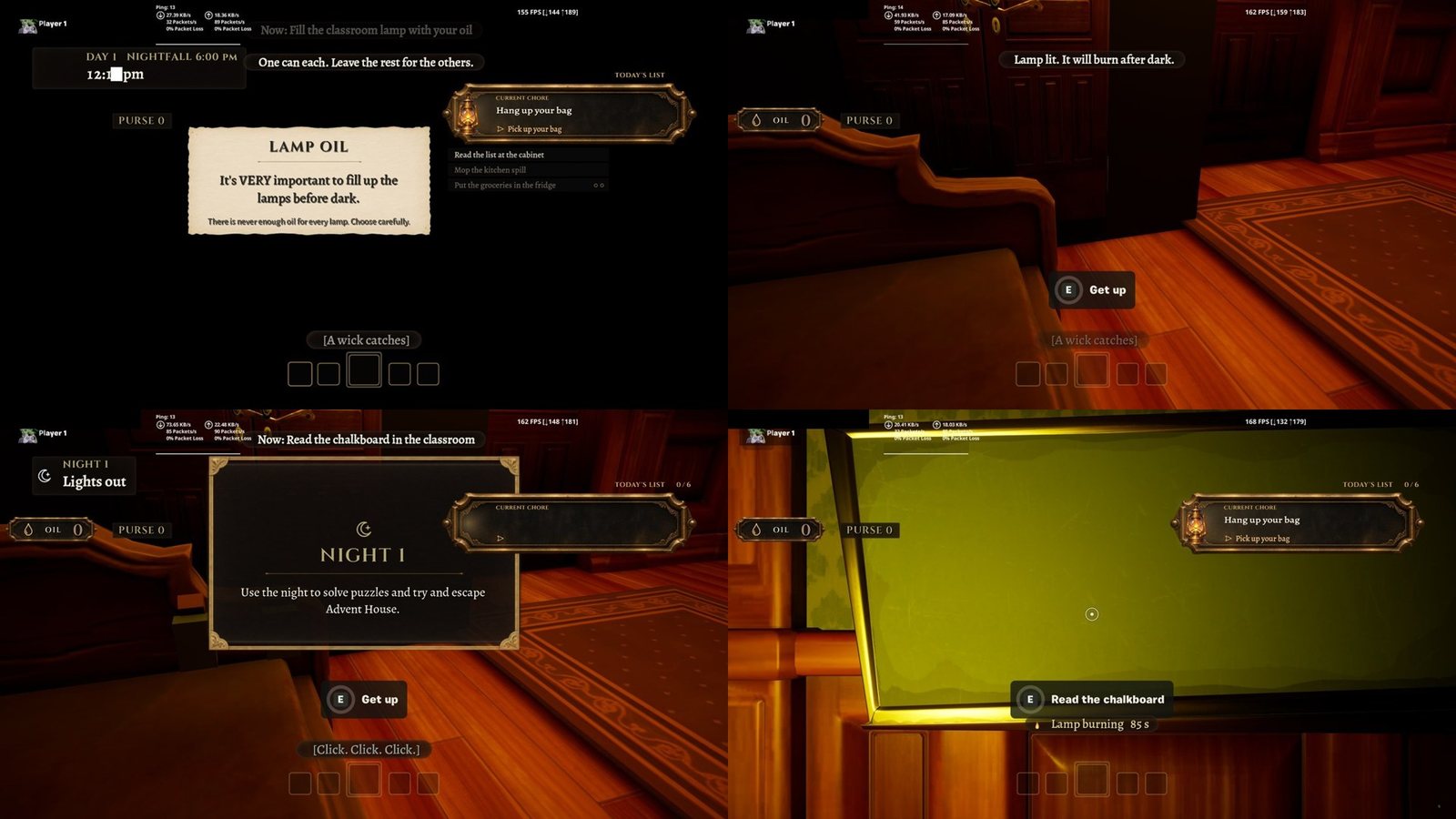
Then comes the lamp lesson: pick up one can of oil, follow the arrows, fill a lamp. At the end of the five-minute day the screen goes black and each child wakes in bed facing a shut door. The first puzzle is a classroom chalkboard. Touching it sets off a shadow that runs across the room, and a laugh.
Watching it in the running game changed the build three times in one night. The coin took five seconds instead of under one, and the first wake-up shot was completely black. Every stage was captured in Fortnite with one player, driven by test scripts. An invisible body cast no shadow in the game, so the figure itself is painted black.
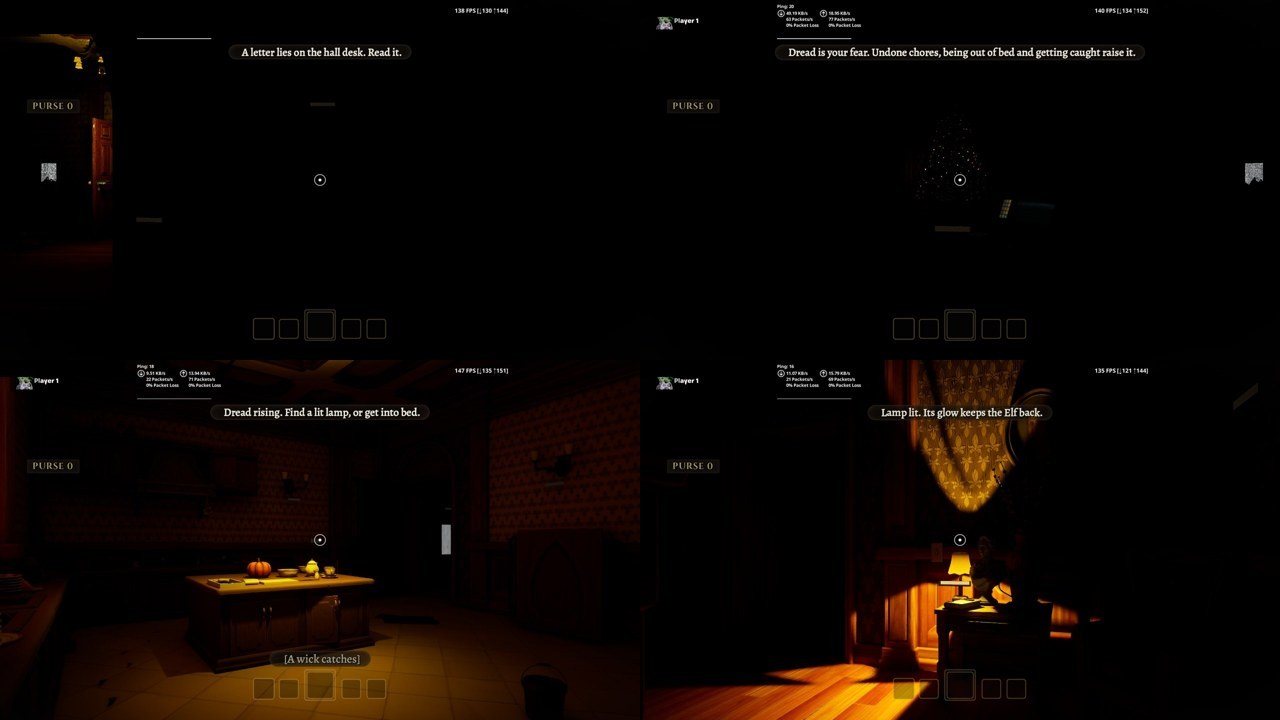
Fortnite runtime test The purse spotlight after the first chore: the screen dims around the purse and my line appears under it. One player, test script.Fortnite runtime test The shadow crosses the classroom past the chalkboard on night 1. Running game, one player, test script.Fortnite runtime test Four stages in the running game: the lamp oil card, waking in bed, the night card and the chalkboard. One player, test script.
Chapter 21
Bring the pieces into one house
The map turns isolated assets into a place players must understand.
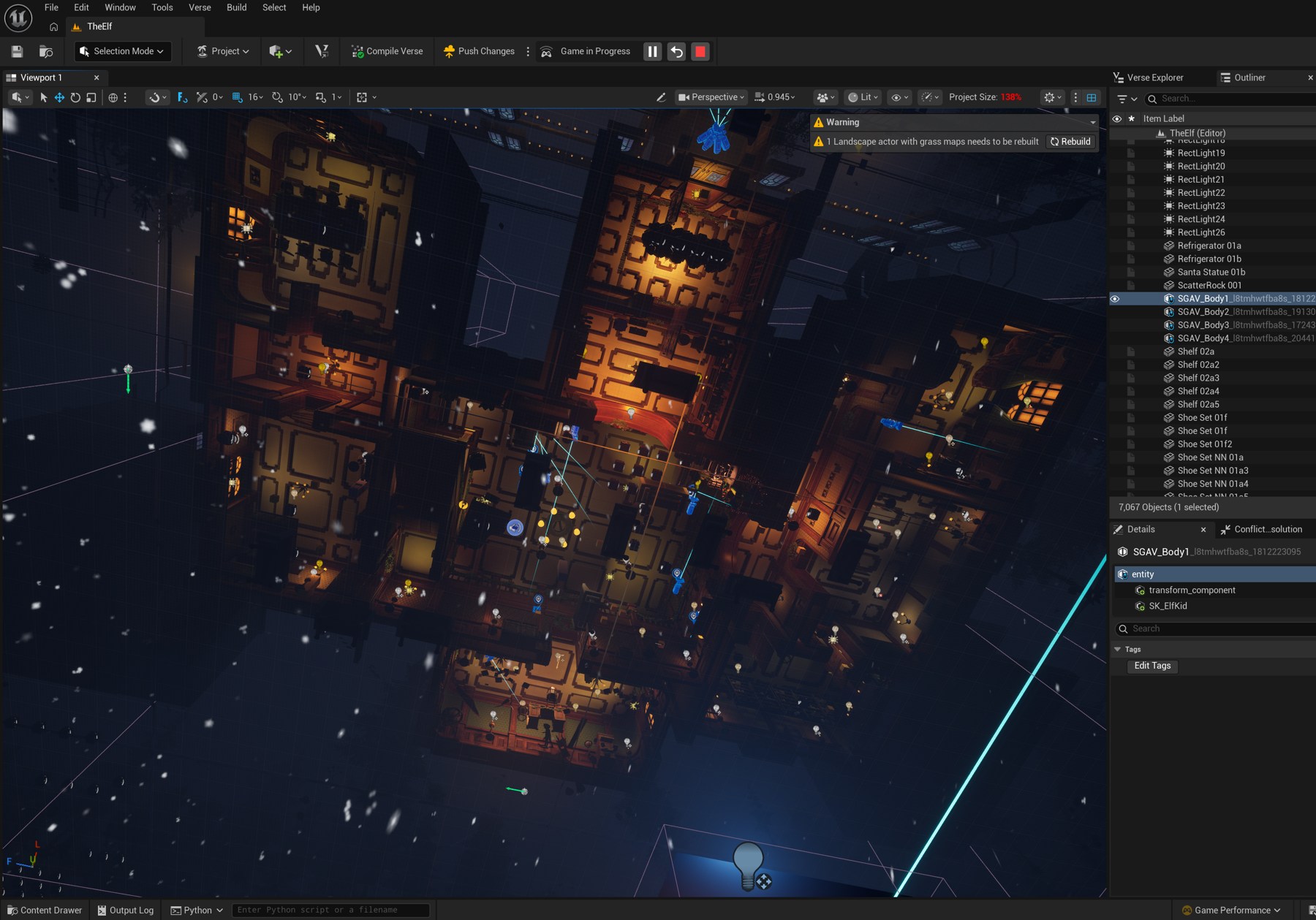
I could look across the connected rooms, furniture and warm pools of light in the UEFN editor. The house was becoming more than a backdrop: routes, sightlines and lamps shaped what players could see and where they felt safe.
I learned to keep the stages distinct: an asset could be created, saved, validated and cooked before anyone had seen it work in play. A clean compile was useful, but it did not tell me whether a player could understand and finish an interaction. Merge recovery and interaction fixes were part of that work.
For Director’s Cut, my role was to choose a coherent look, reject incorrect output, preserve the technical constraints and decide what belonged in the playable experience. This is the development story. The final private version is the record of what actually shipped.
UEFN editor UEFN editor map overview captured. Editor view, not a final-build performance or gameplay certification.
Chapter 22
What the playtests changed
The last day was mostly listening to people who got lost, stuck or could not see.
Until the last two days almost every result on record came from one player, often moved by a test script. Real play was blunt. In my first night test the elf did not move and I could not find a lamp. Players kept walking out of the front door, and the night was too dark to play.
“also dont let the front doors be opened anymore. players keep leaving the house and wandering”
My direction, recorded during development.
Each report became a change the same day: locked front doors, fog all day, starter oil, a larger elf with a louder bell, and a build number in the corner. The largest real match on record is two players. I have no record of a four-player match.
Watching people play changed what I prioritized. A clear route, readable lighting and an understandable next action mattered as much as the characters and cinematics. These captures document the development process and the tests I reviewed.
Fortnite runtime test The chore list on its paper sheet, from my final-evening development recording, played by hand. The build stamp is at the lower left.
By the numbers
What went into The Elf
The development, by the numbers.
55,497
lines of Verse code
Nonblank, non-comment lines across 186 project source files. Includes generated tables and test devices; excludes archived lab copies. A source count, not a count of code exercised in play.
1,128
distinct helper scripts
Python tooling for building, measuring, importing and checking assets. Byte-identical copies removed from 1,144 files; near-duplicate revisions may remain.
4,817
objects placed in the level
Walls, props, lights, cameras and devices in the house and its grounds, including test and parked pieces.
165
animation clips
Animation assets in the game’s own folder, including alternate versions and 17 purchased arms clips. Package references link 96 to the level; that does not prove playback.
163
sound clips
About 22 minutes of audio prepared for the game, mostly cut from purchased libraries, plus synthesized parts and voice lines.
2,839
points on the elf’s map
Floors, walls, ceilings and door frames it can cross while nobody is looking, checked against the decorated house.
3.1 → 1.0 GB
session upload reduced
The project exceeded its 2 GiB session-upload limit. Texture reductions brought the recorded staged upload from 3.1 GB to 1.9 GB, then about 1 GB.
91
experiment plans
Plans across 8 areas explored which Unreal techniques could work in Fortnite. The research record lists 56 reusable techniques; these are not 91 completed tests.
74
rounds of direction
Logged sets of my requests to the agents over the last three days, each with its status.
131
diary entries
The project kept its own diary, with 197 pictures and 90 short clips. This page is drawn from it.
Counted from the shared development workspace. These totals include earlier technical research, experiments and later edits; they are not a count of work created solely during the jam or of assets in the immutable private version.
Process library
Watch the work take shape
Eleven recordings preserve different stages of the workflow. They accompany the written devlog and do not replace the jam’s separate gameplay-video submission.
The threat reaches Fortnite
0:12 • UEFN runtime test
Historical one-player test with scripted views: ceiling encounter, scare and return to the house. This is development evidence, not the final submitted gameplay video.
How the assets were made
4:28 • Process recording
My screen recording of concept and asset work. This is a making-of clip, not the required final gameplay video.
The elf in motion
0:09 • Character preview
A motion test of the blue elf character. External character preview; not Fortnite gameplay.
The Matron performs
0:08 • Character preview
A short character performance reference. Not a demonstration of in-game patrol or AI behavior.
Run, fall, recover, grip
0:09 • Unreal prototype
The Mac Unreal workshop rehearsal. Baked fall and calibrated desk contact; not a general ragdoll or UEFN gameplay proof.
The Matron’s welcome
0:19 • Fortnite runtime test
Part of the Matron’s cutscene from my final-evening development recording, cropped to the picture. Silent here: the subtitles carry her lines.
Look up, and it drops
0:14 • Fortnite runtime test
The elf clings to the hall ceiling, then lies on the floor like a dropped toy once the player looks up. One player, scripted views.
The arrival, second version
0:15 • Fortnite runtime test
The ride with the purchased vehicle model and heavier fog. The porch is still blocks and a stand-in figure waits at the door. One player.
A coin flies to the purse
0:12 • Fortnite runtime test
The first chore pays out, the coin flies to the purse and the screen dims around it. One player, test script. The picture is dark by design.
Four elves, one player
0:15 • Fortnite runtime test
Four player elves come down the hall stair. Three are ghost copies that follow the one real player, used to preview a four-player look.
The first blackout
0:12 • Fortnite runtime test
Night falls in the early gray-box build and the hall lights go out one circuit at a time. I later replaced this system with oil lamps.